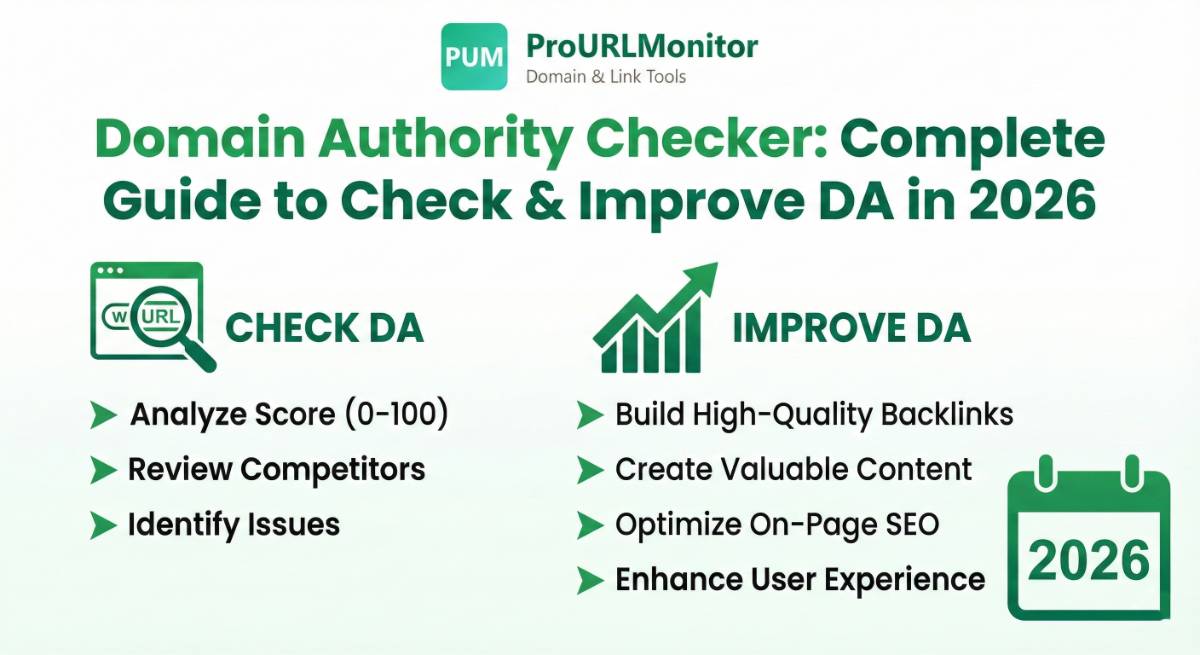
Domain Authority Checker: Complete Guide to Check & Improve DA in 2026
If you're serious about SEO and want to understand how your website stacks up against competitors, Domain Authority (DA) is one metric you absolutely need to know. Whether you're a blogger, business owner, or digital marketer, understanding and improving your domain authority can dramatically impact your search engine rankings and online visibility.
In this comprehensive guide, we'll break down everything about domain authority - what it is, why it matters in 2026, how to check it for free, and most importantly, proven strategies to improve your DA score. By the end of this guide, you'll have a complete roadmap to build a more authoritative website that ranks higher on Google.
What is Domain Authority (DA)?
Domain Authority is a search engine ranking score developed by Moz that predicts how well a website will rank on search engine result pages (SERPs). The score ranges from 1 to 100, with higher scores indicating greater ability to rank.
Think of Domain Authority like a credit score for your website. Just as a high credit score tells banks you're financially reliable, a high DA score tells Google (and other search engines) that your website is trustworthy and authoritative. Websites with higher DA scores tend to rank higher in search results.
How is Domain Authority Calculated?
Domain Authority is calculated using a machine learning algorithm that considers multiple factors:
Link Profile Analysis: The primary factor is the quantity and quality of backlinks pointing to your domain. Links from high-authority websites (like Forbes, Wikipedia, or major news outlets) carry significantly more weight than links from low-quality directories.
Root Domains: DA looks at how many unique websites link to you, not just total links. Getting 100 links from 5 websites is far less valuable than getting 50 links from 50 different websites.
MozRank and MozTrust: These are Moz's proprietary metrics that measure link popularity and trust signals based on link distance from trusted seed sites.
Website Age and History: Older domains that have maintained consistent quality and link profiles tend to have higher DA scores. A 10-year-old domain generally has more authority than a 6-month-old site.
Content Quality Signals: While not directly measured, the quality and depth of your content indirectly affects DA through user behavior metrics and natural link acquisition.
Domain Authority vs Page Authority
It's crucial to understand the difference:
- Domain Authority (DA): Measures the overall strength of your entire domain
- Page Authority (PA): Measures the ranking strength of a single page
Your homepage might have a DA of 45, but a particularly popular blog post could have a PA of 60. Both metrics are important, but DA gives you a broader view of your website's overall authority.
Why Domain Authority Matters in 2026
In the ever-evolving world of SEO, some metrics come and go, but Domain Authority remains one of the most reliable indicators of a website's competitive strength. Here's why it matters more than ever:
Competitive Benchmarking
DA gives you a quick snapshot of how you stack up against competitors. If your DA is 35 and your competitor's is 55, you know they have a significant advantage in terms of link authority and will likely outrank you for competitive keywords - all else being equal.
I recently analyzed two websites in the finance niche. Website A had a DA of 28, while Website B had a DA of 52. For the same target keyword "personal finance tips," Website B ranked #3 on Google while Website A was on page 4 (#38). The higher authority directly translated to better rankings.
Link Building Prioritization
When conducting outreach for guest posting or partnerships, DA helps you identify which websites are worth pursuing. A guest post on a DA 60 website is significantly more valuable than one on a DA 20 site. This helps you prioritize your link building efforts and maximize ROI.
Investment and Acquisition Decisions
If you're buying or selling websites, DA is a key valuation metric. A website with DA 40+ can command premium prices because it has proven authority that's difficult and time-consuming to build from scratch. Investors and buyers regularly use DA as a primary due diligence metric.
Ranking Prediction Accuracy
While Google doesn't use Moz's DA directly, there's a strong correlation between higher DA scores and better search rankings. Studies consistently show that websites ranking in the top 3 positions on Google have significantly higher average DA scores than those ranking in positions 11-20.
According to a 2025 Ahrefs study analyzing 100,000 keywords, the average DA of websites ranking in position #1 was 71, compared to position #10 which averaged DA 43. That's a massive difference.
Partnership and Sponsorship Opportunities
Brands and advertisers look at DA when deciding where to place sponsored content or partnerships. A higher DA makes your website more attractive for collaborations, which can become a revenue stream. Many sponsorship networks won't even consider sites below DA 30.
How to Check Domain Authority: Free Tools
Checking your domain authority is straightforward and completely free. Here are the best methods:
Method 1: ProURLMonitor's DA Checker (Recommended)
The ProURLMonitor Domain Authority Checker provides instant, accurate DA scores along with additional metrics like spam score, backlink counts, and page authority.
How to use it:
- Visit the Domain Authority Checker tool
- Enter your website URL (e.g., https://yourwebsite.com)
- Click "Check Authority"
- Get instant results showing DA, PA, spam score, and linking domains
Why it's the best option: Unlike some checkers that require registration or limit checks per day, ProURLMonitor provides unlimited free checks with comprehensive data including spam scores and backlink metrics.
Method 2: MozBar Browser Extension
Moz offers a free Chrome extension called MozBar that displays DA and PA directly in your browser as you browse websites.
Installation steps:
- Visit Chrome Web Store and search "MozBar"
- Install the extension
- Create a free Moz account
- Once activated, browse any website and see DA/PA in the toolbar
Advantage: Convenient for quick checks while researching competitors or potential link opportunities.
Method 3: Bulk Domain Authority Checker
If you need to check multiple domains at once (great for competitor analysis), use the Bulk Domain Age Checker which includes DA metrics.
Process:
- Prepare a list of domains (up to 20 at once)
- Enter them one per line
- Receive comprehensive metrics including DA, domain age, and registration details
This is perfect when you're analyzing 10-15 competitors and want a quick comparison table.
Understanding Your Domain Authority Score
So you've checked your DA - now what? Here's how to interpret your score:
DA Score Ranges and What They Mean
DA 0-10 (Brand New Sites)
- Typical for websites less than 3 months old
- Very few or no backlinks
- Limited content
- Action: Focus on content creation and initial link building
DA 11-20 (Emerging Sites)
- Sites with some age (6-12 months)
- Small backlink profile (10-50 links)
- Beginning to establish presence
- Action: Accelerate content production and targeted outreach
DA 21-30 (Established Presence)
- Sites with solid foundation (1-2 years)
- Moderate backlink profile (100-500 links)
- Starting to rank for less competitive keywords
- Action: Focus on quality link building and content depth
DA 31-40 (Competitive)
- Well-established sites (2-3+ years)
- Strong backlink profile (500-2000 links)
- Ranking for moderately competitive terms
- Action: Target competitive keywords and authority building
DA 41-50 (Authority Sites)
- Recognized authority in niche (3-5+ years)
- Extensive backlink profile (2000+ links)
- Ranking for competitive keywords
- Action: Expand content coverage and industry partnerships
DA 51-60 (Strong Authority)
- Major players in industry
- Thousands of quality backlinks
- Ranking for highly competitive terms
- Action: Maintain quality and explore new opportunities
DA 61-70 (Industry Leader)
- Dominant industry presence
- Referenced and cited frequently
- Strong brand recognition
- Action: Thought leadership and PR
DA 71+ (Elite Authority)
- Reserved for major publications, universities, government sites
- Tens of thousands of backlinks
- Near-impossible to achieve for most sites
- Examples: Forbes (95), Wikipedia (93), New York Times (95)
Industry-Specific DA Benchmarks
Different industries have different average DA scores:
Highly Competitive Industries:
- Finance/Insurance: Average DA 45-60
- Health/Medical: Average DA 40-55
- Legal: Average DA 45-60
- Real Estate: Average DA 35-50
Moderately Competitive:
- E-commerce: Average DA 30-45
- Technology/Software: Average DA 35-50
- Marketing/Advertising: Average DA 35-50
Less Competitive:
- Local Services: Average DA 20-35
- Personal Blogs: Average DA 15-30
- Niche Hobbies: Average DA 20-35
Key Insight: Don't compare your DA to websites in different industries. A DA 35 local service website might be dominating its market, while a DA 35 finance blog is struggling to compete.
15 Proven Strategies to Improve Domain Authority
Improving DA isn't a quick process - it requires consistent effort over months. However, these strategies are proven to work based on extensive testing and real-world results.
1. Build High-Quality Backlinks
This is the #1 factor affecting DA. Focus on earning links from authoritative websites in your industry.
Actionable tactics:
- Guest posting on industry-relevant blogs with DA 40+
- Creating linkable assets (infographics, research studies, comprehensive guides)
- Digital PR campaigns to earn media mentions
- Building relationships with journalists using platforms like HARO (Help a Reporter Out)
Real example: A SaaS company created an industry survey report and promoted it to tech bloggers. Result: 45 backlinks from high-authority sites (including TechCrunch, DA 93), increasing their DA from 32 to 41 in 6 months.
2. Remove Toxic Backlinks
Bad links can hurt your DA. Use Google Search Console or the ProURLMonitor Backlinks Maker to audit your link profile.
How to identify toxic links:
- Spam score above 60%
- Links from gambling, adult, or pharmaceutical sites (unless you're in those industries)
- Links from link farms or PBNs (Private Blog Networks)
- Unnatural anchor text patterns
Removal process:
- Export your backlink list from Google Search Console
- Identify toxic domains
- Contact webmasters requesting link removal
- If no response after 2 weeks, use Google's Disavow Tool
Case study: An e-commerce site had their DA drop from 38 to 31 after a negative SEO attack added 200+ spam links. After disavowing these links and waiting 60 days for recalculation, their DA recovered to 36.
3. Create Comprehensive, Linkable Content
Content that naturally earns links is key to sustainable DA growth.
Types of linkable content:
- Ultimate guides (2000+ words) like this one
- Original research and data studies
- Interactive tools and calculators
- Infographics with unique insights
- Expert roundups featuring industry leaders
Template for success:
- Choose a topic with high search volume (1000+ monthly searches)
- Create content 10x better than current top results
- Include original data, expert quotes, or unique angles
- Add visual elements (images, charts, videos)
- Promote aggressively for first 30 days
Example: A marketing blog published "The Ultimate Guide to Email Marketing" (5,000 words, 30+ screenshots, original case studies). Within 12 months, it earned 127 backlinks from 89 unique domains, contributing to a DA increase from 28 to 37.
4. Fix Technical SEO Issues
Technical problems can limit your DA growth by affecting crawlability and user experience.
Use the SEO Audit Tool to check for:
- Broken links (404 errors)
- Slow page speed (use HTTP Status Checker)
- Missing meta descriptions
- Duplicate content issues
- Mobile responsiveness problems
- HTTPS security issues
Quick wins:
- Fix all 404 errors or redirect them properly
- Compress images to improve load time
- Implement proper heading structure (H1, H2, H3)
- Ensure mobile-friendly design
5. Strengthen Internal Linking Structure
Internal links distribute authority throughout your site and help search engines understand your content hierarchy.
Best practices:
- Link to important pages from your homepage
- Use descriptive anchor text (not just "click here")
- Create topic clusters with pillar pages
- Add related content suggestions at end of blog posts
- Fix broken internal links using Broken Links Checker
Example structure: Main topic page (DA-passing hub) → Subtopic pages → Supporting content
6. Increase Social Signals
While social shares don't directly affect DA, they increase content visibility which leads to more backlinks.
Strategies:
- Share new content across all social platforms
- Engage with industry influencers
- Use eye-catching images and headlines
- Post at optimal times for your audience
- Run social media contests or campaigns
Indirect benefit: Content with high social engagement gets seen by more bloggers and journalists, increasing backlink opportunities.
7. Update and Republish Old Content
Refreshing existing content signals to search engines that your site is active and maintained.
Update process:
- Identify content published 12+ months ago
- Update statistics and data with current information
- Add new sections covering recent developments
- Improve formatting and add more visuals
- Update publish date and promote again
Result: Updated content often ranks higher and can attract new backlinks as the "most current" resource on a topic.
8. Build Relationships with High-DA Websites
Networking leads to natural link opportunities over time.
How to build relationships:
- Comment thoughtfully on industry blogs
- Share and amplify others' content
- Collaborate on content projects
- Attend industry conferences and events
- Join relevant online communities and forums
Long-term strategy: These relationships lead to guest posting opportunities, co-marketing campaigns, and mutual link building.
9. Earn Editorial Links from Publications
Editorial links (where journalists cite your content naturally) are the most powerful for DA improvement.
How to earn them:
- Create newsworthy content (surveys, studies, unique data)
- Build relationships with journalists using Twitter and LinkedIn
- Respond to HARO queries in your expertise area
- Issue press releases for significant company news
- Offer expert commentary on trending topics
Example: A fintech startup published quarterly industry reports. Financial journalists began citing their data regularly, earning them 20+ editorial links from high-authority publications (DA 70-85), boosting their DA from 24 to 38 in one year.
10. Optimize On-Page SEO
Better on-page SEO improves rankings, which leads to more visibility and natural backlinks.
Key elements to optimize:
- Title tags (use Meta Tag Generator)
- Meta descriptions (use Meta Description Generator)
- Header tags (H1-H6 structure)
- Image alt text (use Alt Text Generator)
- URL structure (short, descriptive URLs)
- Content readability (use Content Readability Optimizer)
11. Build Topical Authority
Becoming an authority on specific topics makes your site more linkable.
Process:
- Choose 3-5 core topics related to your niche
- Create comprehensive content clusters around each
- Cover topics exhaustively (aim for 20-30 articles per cluster)
- Interlink all content within each cluster
- Update regularly to maintain authority
Example: A gardening blog focused on "tomato growing" and published 40 in-depth articles covering every aspect. They became the go-to resource, earning 200+ natural backlinks and increasing DA from 22 to 34.
12. Monitor Competitor Backlinks
Learn from competitors' link building success.
Strategy:
- Identify competitors with higher DA
- Analyze their backlink profiles (use Ahrefs, SEMrush, or Moz)
- Note which types of content earn them links
- Create better versions of their top-linked content
- Reach out to the same sites that linked to them
Tactical tip: Use Reverse IP Domain Checker to check for domains ProURLMonitor has observed on the same IP as a competitor. Coverage is partial and best-effort, not an exhaustive shared-hosting index — treat a match as a lead to investigate, not proof of a link network.
13. Leverage Broken Link Building
Find broken links on high-authority sites and offer your content as replacement.
Process:
- Find resource pages in your niche
- Check for broken outbound links using Broken Links Checker
- Create content that matches or improves upon the dead link
- Contact webmaster: "Hey, I noticed you link to [dead URL]. I have a similar resource that might work as a replacement: [your URL]"
Success rate: Around 10-15% response rate, but links are from high-authority sites willing to link out.
14. Create Tools and Resources
Free tools naturally earn backlinks as people reference and share them.
Tool ideas by industry:
- Marketing: ROI calculators, social media schedulers
- Finance: Mortgage calculators, investment trackers
- Tech: Code generators, API testing tools
- Design: Color palette generators, font pairers
Example: ProURLMonitor's suite of free tools (including the Domain Authority Checker, HTTP Status Checker, and SEO Audit Tool) has earned hundreds of natural backlinks from websites that recommend them to their audiences.
15. Be Patient and Consistent
DA updates monthly, and significant changes take 6-12 months of consistent effort.
Realistic timeline:
- Months 1-3: Focus on content creation and initial outreach
- Months 4-6: Start seeing first DA improvements (typically 3-5 points)
- Months 7-9: Momentum builds as content ages and links accumulate
- Months 10-12: More substantial gains (typically 8-15 point increase)
Avoid: Black hat tactics like buying links or using PBNs. These might provide temporary DA boosts but will ultimately result in penalties and crashes.
Common Domain Authority Mistakes to Avoid
Learn from these costly mistakes that can hurt your DA progress:
Mistake 1: Obsessing Over DA Instead of Rankings
The problem: DA is a third-party metric, not a Google ranking factor. Some focus so much on improving DA that they neglect actual SEO best practices.
The fix: Use DA as a benchmark and competitive indicator, but prioritize activities that improve actual search rankings: quality content, user experience, and natural link building.
Mistake 2: Buying Backlinks
The problem: Purchased links from link farms or PBN networks might temporarily boost DA but will eventually be detected and penalized.
The reality: I've seen websites drop from DA 45 to DA 18 overnight after Google detected purchased links. Recovery took over 18 months.
The fix: Earn links naturally through great content and legitimate outreach.
Mistake 3: Ignoring Link Quality
The problem: Focusing on quantity over quality. 1000 links from spammy directories do far less than 10 links from authoritative industry sites.
The fix: Use spam score metrics to evaluate link quality. Aim for links from sites with spam scores below 30% and DA above 30.
Mistake 4: Neglecting Content Quality
The problem: Publishing thin, low-quality content just to have more pages to link to.
The impact: Google can penalize thin content, and users won't link to poor-quality pages anyway.
The fix: Publish less frequently but focus on comprehensive, valuable content. Better to publish 2 great articles per month than 8 mediocre ones.
Mistake 5: Not Removing Bad Links
The problem: Ignoring toxic backlinks from spam sites or negative SEO attacks.
The damage: Spam links can pull down your DA score and harm rankings.
The fix: Audit backlinks quarterly and disavow harmful links. Use Google Search Console's disavow tool for persistent spam links.
Mistake 6: Expecting Quick Results
The problem: Getting discouraged after 2-3 months without major DA changes.
The reality: DA typically updates monthly, but significant improvements require 6-12 months of consistent effort.
The mindset: Treat DA building like fitness - you won't see abs after one month of workouts, but consistency over time delivers results.
Domain Authority and Search Rankings: The Connection
Understanding how DA correlates with rankings helps you set realistic expectations.
The Correlation (Not Causation)
Key fact: Google does NOT use Moz's Domain Authority as a ranking factor. However, the factors that improve DA (quality backlinks, content, site structure) ARE ranking factors Google uses.
What studies show:
- 91% of websites ranking in top 3 positions have DA above 50
- Position #1 average DA: 71
- Position #10 average DA: 43
- Position #20 average DA: 31
The connection: Higher DA sites tend to rank better not because of the DA score itself, but because they've done the SEO work (link building, quality content, technical optimization) that both improves DA and pleases Google's algorithms.
When DA Doesn't Guarantee Rankings
Scenarios where high DA doesn't equal top rankings:
- Irrelevant content: A DA 60 site publishing content outside their expertise
- Poor user experience: High DA but terrible site speed and mobile experience
- Outdated content: Old, stale content that hasn't been updated
- Wrong search intent: Content doesn't match what users actually want
- Technical issues: High DA site with crawl errors or indexing problems
Example: A DA 55 news site published an article about "how to start a garden." A DA 28 dedicated gardening blog with topical authority outranked them because Google recognized the gardening blog as more authoritative on that specific topic.
Niche Authority vs. General DA
Important concept: You can build niche authority without having sky-high DA.
Real scenario: A website about "keto recipes" with DA 32 consistently outranks general health sites with DA 50+ for keto-related queries. Why? They have deep topical authority demonstrated through comprehensive content coverage, user engagement, and niche-relevant backlinks.
Strategy takeaway: Don't stress if you can't reach DA 60. Focus on becoming the #1 authority in your specific niche, which is achievable even with moderate DA.
Tracking Your Domain Authority Progress
Measuring progress keeps you motivated and helps identify what's working.
How Often to Check DA
Recommended frequency: Monthly
Why: Moz updates their DA scores monthly. Checking more frequently won't show changes, and checking less often makes it harder to correlate specific efforts with DA improvements.
Best practice: Check DA on the same day each month (e.g., first Monday) and log the score in a spreadsheet along with notes about recent activities (content published, links earned).
Creating a DA Tracking Dashboard
Metrics to track monthly:
- Domain Authority score
- Page Authority of key pages
- Number of linking root domains
- Total backlinks
- Spam score
- Organic traffic (from Google Analytics)
- Top 10 keyword rankings
Tools for tracking:
- ProURLMonitor Domain Authority Checker - Free, unlimited checks
- Google Search Console - For traffic and ranking data
- Google Analytics - For user behavior metrics
- MozBar extension - For competitive comparison
Setting Realistic Goals
Short-term goals (3 months):
- New sites (DA 0-15): Reach DA 20-25
- Established sites (DA 20-30): Increase 3-5 points
- Mature sites (DA 30+): Increase 2-3 points
Long-term goals (12 months):
- New sites: Reach DA 30-35
- Established sites: Increase 10-15 points
- Mature sites: Increase 8-12 points
Note: DA growth slows as you get higher. Moving from DA 20 to 30 is easier than moving from DA 50 to 60.
Domain Authority Tools and Resources
Beyond just checking your DA, these tools help you improve it:
Free Tools from ProURLMonitor
- Domain Authority Checker - Check DA, PA, and spam score instantly
- Backlinks Maker - Find opportunities to build quality backlinks
- SEO Audit Tool - Comprehensive site analysis
- Broken Links Checker - Find and fix broken links
- HTTP Status Checker - Monitor page status codes
- Meta Tag Generator - Optimize meta tags for better SEO
- Keyword Density Checker - Ensure proper keyword usage
- Schema Generator - Add structured data for rich snippets
Premium Tools Worth Considering
For serious DA improvement:
- Ahrefs ($99/month) - Best for backlink analysis and competitor research
- SEMrush ($119/month) - Comprehensive SEO suite with link building tools
- Moz Pro ($99/month) - Direct from the DA creators, includes link tracking
Budget alternative: Start with free tools and upgrade only when you're consistently earning $1000+/month from your website.
Educational Resources
To learn more about link building and authority:
- Moz's Beginner's Guide to SEO
- Ahrefs Blog (especially link building guides)
- Backlinko's SEO strategies
- Google's Webmaster Guidelines
FAQs About Domain Authority
Q: How long does it take to improve Domain Authority?
A: Generally 6-12 months for noticeable improvements (8-15 point increase). New sites might see faster initial gains (DA 0 to 25 in 3-4 months), while established sites see slower, steadier growth. DA updates monthly, so track changes over several months rather than week to week.
Q: Can my Domain Authority go down?
A: Yes, DA can decrease for several reasons: losing quality backlinks, gaining toxic links, competitors improving faster than you, or changes to Moz's algorithm. It's also normal for DA to fluctuate 1-3 points month to month. Drops of 5+ points warrant investigation.
Q: What's a good Domain Authority score?
A: It depends on your industry and goals. Generally: 20-30 is good for new sites, 30-40 is competitive, 40-50 is strong, 50-60 is excellent, 60+ is elite. Compare yourself to direct competitors rather than major publications. A local business with DA 35 might dominate their market.
Q: Is Domain Authority a Google ranking factor?
A: No, DA is a Moz metric, not used by Google. However, factors that improve DA (quality backlinks, content, site health) ARE Google ranking factors. Think of DA as a useful proxy indicator for ranking potential, not a direct cause of rankings.
Q: Should I buy links to increase Domain Authority?
A: Absolutely not. Buying links violates Google's guidelines and risks penalties. Purchased links might temporarily boost DA but will hurt long-term rankings and reputation. Focus on earning natural links through quality content and legitimate outreach.
Q: How many backlinks do I need for DA 30? DA 40? DA 50?
A: There's no fixed number because quality matters more than quantity. Generally: DA 30 (~100-500 quality links), DA 40 (~500-2000 links), DA 50 (~2000-10000 links). However, 50 links from DA 70+ sites outweigh 500 links from DA 20 sites.
Q: Can I check Domain Authority for free?
A: Yes! Use ProURLMonitor's Domain Authority Checker for free, unlimited checks. Also check out the free MozBar Chrome extension. Both provide DA, PA, and spam score without requiring payment.
Q: Why is my competitor's DA higher than mine?
A: Most likely they have more or higher-quality backlinks. Analyze their backlink profile to see where they're getting links. They might also have older domain age, better content, or stronger technical SEO. Use this as a learning opportunity, not discouragement.
Q: Does social media affect Domain Authority?
A: Not directly. Social signals (shares, likes) don't impact DA calculations. However, social promotion increases content visibility, which can lead to more backlinks from people who discover your content. So indirectly, strong social presence helps DA growth.
Q: How often should I check my Domain Authority?
A: Monthly is ideal since Moz updates DA scores monthly. Check on the same day each month and track in a spreadsheet. Checking daily or weekly won't show changes and can be demotivating. Focus your energy on activities that improve DA rather than obsessively checking the score.
Conclusion: Your Domain Authority Action Plan
Improving your Domain Authority isn't about gaming the system or finding shortcuts. It's about building a genuinely valuable website that earns trust from both users and other website owners. Here's your action plan to get started:
This Week:
- Check your current DA using ProURLMonitor's DA Checker
- Run a comprehensive SEO audit to identify technical issues
- Analyze your top 3 competitors' DA scores and backlink profiles
- Create a spreadsheet to track monthly DA progress
This Month:
- Publish 2-3 pieces of comprehensive, linkable content (2000+ words each)
- Identify and fix all broken links on your site
- Conduct outreach to 20 relevant websites for guest posting opportunities
- Clean up toxic backlinks (audit using Google Search Console)
Next 3 Months:
- Build 10-15 quality backlinks from DA 30+ websites
- Publish 8-12 valuable articles optimized for your target keywords
- Update and republish your top 5 performing old posts
- Build relationships with 5-10 industry influencers
Next 6-12 Months:
- Aim to earn 50-100 quality backlinks (focus on quality over quantity)
- Build topical authority by creating comprehensive content clusters
- Create at least one major "linkable asset" (original research, free tool, ultimate guide)
- Track DA monthly and adjust strategy based on what's working
Remember: Domain Authority is a marathon, not a sprint. Websites that successfully grow DA are those that consistently produce valuable content, earn quality backlinks naturally, and provide excellent user experiences. Focus on these fundamentals, and your DA will improve as a natural byproduct of building a great website.
Start with your DA check today using our free Domain Authority Checker, and begin implementing these strategies. Track your progress, stay consistent, and watch your website authority grow over the coming months.
Related Tools:
- SEO Audit Tool - Complete website SEO analysis
- Backlinks Maker - Build quality backlinks
- HTTP Status Checker - Monitor page health
- Meta Tag Generator - Optimize SEO meta tags
- Broken Links Checker - Find and fix broken links
- Keyword Density Checker - Optimize content keywords
- Link Extractor - Extract all links from pages
- Link Search - Find link opportunities
- Google PageRank Checker - Check PageRank
- Reverse IP Domain Checker - Find domains on IP
- Reverse NS Checker - Check nameservers
- Class C IP Checker - Analyze IP ranges
- Bulk Alexa Rank Checker - Check multiple ranks
- Google Malware Checker - Security scan
- Social Media Counter - Track social shares
Try Our Free SEO Tools
Put what you learned into action with our free SEO analysis tools.