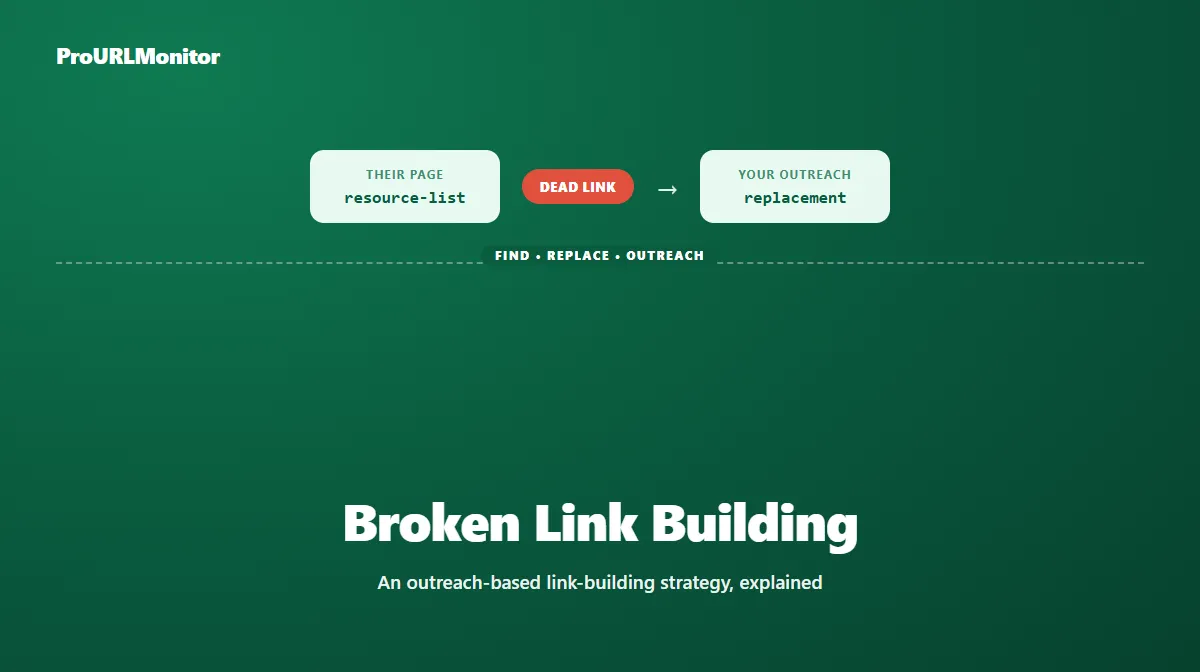
Broken Link Building: How It Works and How to Start
Despite the name, broken link building has nothing to do with fixing broken links on your own site. It's a link-acquisition strategy aimed at other people's websites: you find a link on someone else's page that no longer works, put together (or already have) a piece of content that would make a genuinely good replacement, and let the page owner know — with the hope that they'll swap the dead link for a link to yours.
If you landed here looking to fix broken links on your own site instead, that's a different task entirely — see our guide on how to find and fix broken links.
What Is Broken Link Building?
It's an off-page SEO tactic built on a simple observation: every site accumulates dead outbound links over time, and most site owners don't know about the ones on their own pages until someone tells them. Broken link building turns that into an opportunity — you do the telling, and you bring a solution with you.
The basic shape of it: find a broken external link on a page you don't control, confirm you have (or can create) content that's a genuinely strong fit as a replacement, and reach out to whoever maintains that page suggesting the swap.
How It Actually Works
- Find a relevant page with a dead outbound link. Resource pages, "further reading" lists, and curated link roundups are common targets, since they exist specifically to link out to other content.
- Confirm the link is actually broken — not just blocked, redirected, or slow to load. A quick manual check or a tool that reports the real HTTP status avoids wasting an outreach email on a link that turns out to be fine.
- Evaluate whether your replacement is genuinely a fit. Not "close enough" — a real match for what the original link was trying to provide.
- Find the right contact for that specific page, not just a generic inbox if you can help it.
- Send a short, specific, non-spammy message pointing out the broken link and suggesting your resource as a replacement.
- Follow up once if you don't hear back, and then let it go.
Why Site Owners Actually Make the Swap
This only works because there's a real, mutual benefit. A broken link on their page is a small quality problem — it looks unmaintained, and gives visitors a bad experience. You're not asking for a favor with nothing in return; you're pointing out something worth fixing and making the fix easy by handing them a suitable replacement. That's a meaningfully different pitch from "please link to me," and it's why this approach has a legitimate reputation compared to tactics built purely around asking.
Finding Broken Link Building Opportunities
Resource and "useful links" pages in your niche are the classic hunting ground — they exist to collect outbound links, which means they accumulate rot as the sites behind those links change over the years. Searching your topic alongside terms like "resources," "links," or "further reading" surfaces a lot of these pages quickly.
For anything beyond manual searching, this is genuinely a job for dedicated backlink-analysis tools — platforms like Ahrefs or Semrush that maintain their own large-scale backlink and web-crawl databases, built specifically to surface broken links across thousands of pages or a competitor's known backlink profile at once. That's a different kind of tool than a page- or sitemap-based broken link checker, which is built to answer "is this specific set of links, on this specific page or site, currently working?" — not "which pages across the web currently have a dead link in this topic area?"
Where a link checker does help here: once you've found a candidate page and a specific link you think is broken, running that page through ProURLMonitor's Broken Links Checker confirms the link is actually dead (rather than just slow, blocked, or temporarily rate-limited) and shows you the status of everything else on that page in the same pass — useful context before you reach out.
Evaluating Whether an Opportunity Is Actually Relevant
The single biggest factor in whether this works is relevance, not volume. A broken link about a topic tangential to your content isn't a good opportunity just because it's broken — pitching a mismatched replacement reads as exactly what it is, and wastes the page owner's time and your own. Before reaching out, ask honestly: if this link weren't broken, would my page be a genuinely sensible thing to have linked there in the first place?
Creating or Selecting a Genuinely Useful Replacement
The replacement needs to actually serve the purpose the original link did — the same depth, the same specificity, ideally the same format (a guide replacing a guide, a tool replacing a tool). If nothing you have fits, that's a signal to either create something that does or skip the opportunity, not to force an unrelated page into the pitch.
Finding Appropriate Contact Information
Look for a named editor, author, or "about" page before falling back to a generic contact form or info@ address — a message addressed to a specific person, referencing their specific page, reads as considerably less templated than one sent into a general inbox.
Writing Useful, Non-Spammy Outreach
Keep it short, lead with the specific problem (their page, their broken link — named exactly), and make the ask easy to act on. A message that's clearly personalized to that one page, rather than an obvious mail-merge, is the difference between "someone actually looked at my site" and something that gets deleted unread.
Personalization Matters More Than Volume
A handful of carefully matched, well-written pitches to genuinely relevant pages will outperform a much larger batch of generic ones sent without checking for fit. This is inherently a quality-over-quantity tactic — treating it as a numbers game tends to produce outreach that reads as exactly that.
Following Up Without Harassment
One polite follow-up after a reasonable interval (a couple of weeks) is normal and expected. Repeated follow-ups past that point cross into harassment territory and are more likely to get you blocked or flagged as spam than to produce a reply.
Measuring Results
Track what you sent, to whom, and what happened — replies, placements, no response — so you can tell which types of pages and pitches actually work for your niche over time. Don't expect (or promise anyone) a specific response or acceptance rate; it depends entirely on relevance and the quality of your outreach, and treating any number you've seen quoted elsewhere as a guarantee will only set you up for disappointment.
Common Mistakes
- Pitching irrelevant content just because a link happened to be broken
- Mass, unpersonalized outreach sent to every broken link you can find regardless of fit
- Not verifying the link is actually broken before reaching out (blocked, slow, or redirected isn't the same as dead)
- Overly aggressive or repeated follow-ups
- Treating the replacement as an afterthought instead of genuinely matching the original's purpose
Scalability Limitations
This isn't a tactic that scales the way some others do. Each opportunity requires manually confirming relevance and often creating or adapting content to fit — there's no shortcut that preserves quality at high volume. That's a feature more than a bug: the tactic works because of the care taken on each pitch, and skipping that care to go faster is what turns it into the kind of outreach people ignore or report.
Ethical Considerations
Be straightforward about who you are and why you're reaching out — don't misrepresent the relationship or pretend to be a random reader who "just happened to notice." Only suggest replacements you genuinely believe serve the page's original purpose, not whatever you'd most like linked. And respect a "no" or no response as the end of that particular outreach attempt.
Broken Link Building vs. Fixing Your Own Broken Links
Worth restating plainly, since the names invite confusion: fixing your own broken links is website maintenance — finding dead links on pages you control and correcting them, covered in our guide on how to find and fix broken links. Broken link building is outreach aimed at earning a backlink from someone else's site. They share a starting point (a link that doesn't work) and nothing else about the workflow.
Broken Link Building vs. Other Link-Building Strategies
Compared to guest posting or digital PR, broken link building has a narrower, more mechanical starting point — you need an existing dead link to work with, rather than pitching a topic or a story from scratch. That makes it more predictable in structure but also more limited in volume: you're constrained by how many genuinely relevant broken links you can actually find, not by how much content you're willing to write.
Frequently Asked Questions
What is broken link building?
Broken link building is an off-page SEO tactic where you find a dead external link on someone else's page, create or locate a genuinely relevant piece of content that could replace it, and reach out to the page owner suggesting they link to your resource instead of the broken one. It's a way of earning backlinks by fixing a real problem for the site owner, not by asking for a link with nothing in return.
Is broken link building the same as fixing broken links on my own site?
No — these are two unrelated activities that happen to share a name. Fixing your own site's broken links is website maintenance: finding dead links on pages you control and correcting them. Broken link building is outreach aimed at other people's websites, done to earn a backlink for yourself. If you're here for the maintenance side, see our guide on how to find and fix broken links instead.
Does broken link building guarantee backlinks?
No. It's an outreach tactic, and outreach only works when the recipient decides your replacement is genuinely worth linking to and takes the time to make the change. Treat any specific reply or acceptance rate as unpredictable — it depends entirely on relevance, the quality of what you're offering, and how the outreach is written.
How do I find broken link building opportunities?
Resource and links pages in your niche are a good starting point, since they collect many outbound links and tend to accumulate rot over time — searching for terms like your topic plus "resources" or "useful links" surfaces them. Backlink-analysis tools built for this (Ahrefs, Semrush, and similar) can also scan a competitor's known backlink profile or a target site's outbound links for dead ones at scale, which a page- or sitemap-based link checker isn't designed to do.
Can ProURLMonitor's Broken Links Checker find broken link building opportunities for me?
Only in a limited, useful way — it can confirm whether a specific link on a specific page you've already identified is actually still broken, and show you what else on that page needs attention. It checks a page or a sitemap's discovered URLs, though; it doesn't crawl the wider web or maintain a backlink index, so it isn't a substitute for a dedicated backlink database when you're trying to discover opportunities in the first place.
What makes broken link building outreach effective instead of spammy?
Relevance and restraint. Only pitch a replacement that genuinely fits the original link's purpose — not just anything you happen to have published. Personalize each message to the specific page and link, keep it short, lead with the value to them (you're pointing out a real problem on their site), and follow up once, politely, rather than repeatedly.
Is broken link building considered a legitimate SEO tactic?
Yes, when done as described — genuinely helping a site owner fix a real broken link with a relevant replacement is a widely recognized white-hat approach, distinct from tactics that rely on manipulation or mass, irrelevant outreach. It carries the same expectations as any outreach-based link building: relevance, honesty about who you are, and no pressure tactics.
Try Our Free SEO Tools
Put what you learned into action with our free SEO analysis tools.