JWT vs OAuth: What's the Difference?
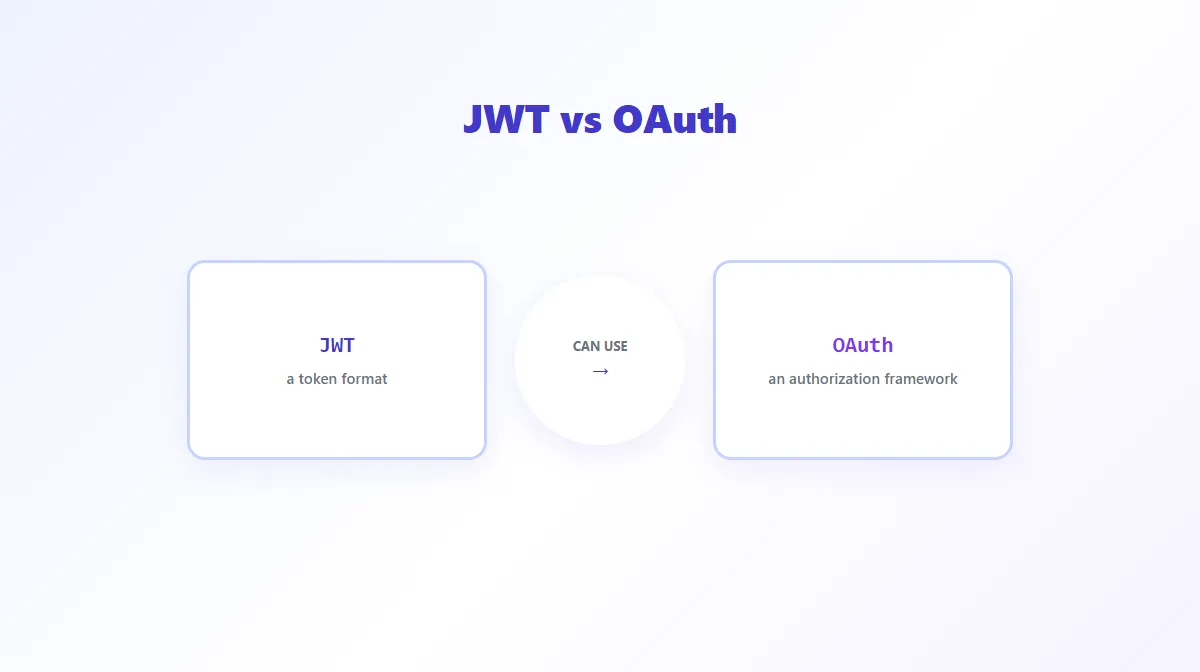
JWT and OAuth are not two competing options for the same job. JWT (RFC 7519) is a compact token format. OAuth 2.0 (RFC 6749) is an authorization framework that defines flows for granting access to resources. In practice, OAuth very often issues access tokens formatted as JWTs — the two are usually partners, not alternatives.
JWT vs OAuth: Quick Comparison
| JWT | OAuth | |
|---|---|---|
| What it is | A token format | An authorization framework |
| Defines | How claims are packaged, signed, and encoded | How a client obtains permission to access a resource |
| Statefulness | Self-contained; a verifier needs no shared session store | Typically involves an authorization server and defined request/response flows |
| Primary job | Carry and prove the integrity of a set of claims | Grant scoped, delegated access without sharing a password |
| Can exist without the other? | Yes — JWTs are used outside OAuth constantly | Yes — OAuth doesn't require JWT-format tokens |
What Is JWT?
A JWT is a signed, three-part token — header, payload, signature — that carries claims like a user ID or an expiration time. Any server holding the correct verification key can check a JWT's signature independently, with no central session database. For the full breakdown of its structure and claims, see What Is JWT? How JSON Web Tokens Work. If you have an OAuth access token or ID token in hand and want to see exactly what claims it carries, our JWT Decoder will decode its header and payload instantly, right in your browser.
What Is OAuth?
OAuth 2.0 is a framework that lets a client application obtain limited access to a resource owner's data on a resource server, without ever handling the resource owner's credentials directly. It defines several "grant types" — flows like Authorization Code (the standard for most web and mobile apps), Client Credentials (for machine-to-machine access), and others — each describing exactly how a client requests and receives an access token from an authorization server.
The classic example: you click "Sign in with Google" on a third-party app. OAuth is the framework that lets that app request limited access to your Google account (say, just your email address) without that app ever seeing your Google password.
How JWT and OAuth Work Together
OAuth defines how a client gets a token. It doesn't dictate what that token looks like on the wire. Most modern OAuth implementations choose to issue JWT-format access tokens because:
- Resource servers can verify a JWT's signature locally, without calling back to the authorization server for every request.
- Claims like
exp,scope, andsubmap naturally onto what an OAuth access token needs to carry.
OpenID Connect (OIDC), an identity layer built on top of OAuth 2.0, goes a step further and requires its ID token to be a JWT specifically. So it's accurate to say: OAuth commonly uses JWTs, and OIDC's ID token is always one — but plain OAuth 2.0 itself never strictly requires it.
JWT vs OAuth: Authentication vs Authorization
This is where the comparison gets muddled the most, so it's worth being precise:
- OAuth 2.0 is fundamentally about authorization — granting access to a resource. It was not designed as an authentication protocol, even though it's frequently misused as one on its own.
- JWT itself is not an authentication protocol. It's a container format. A JWT can carry proof that authentication happened (via its claims), but the format doesn't perform authentication by itself — verifying who a signed token's claims describe still depends on someone having authenticated the user in the first place and signing the resulting claims correctly.
- OpenID Connect is what actually adds standardized authentication on top of OAuth, specifically through its JWT-based ID token.
So neither "JWT" nor "OAuth" alone is properly described as "an authentication protocol" — that job belongs to OIDC, layered on top of OAuth, using JWT as its token format.
When Is JWT Used?
- First-party API authentication, where your own backend issues tokens directly to your own frontend or mobile app after login.
- Stateless microservice-to-microservice calls, where each service verifies a token's signature locally instead of checking a shared session store.
- As the access-token or ID-token format inside an OAuth/OIDC flow.
When Is OAuth Used?
- "Sign in with X" style third-party login, where a user grants a separate application limited access to their account on another service.
- Letting a third-party app call an API (like a calendar or storage API) on a user's behalf, with a specific, limited scope of access.
- Machine-to-machine authorization between services owned by different parties, using the Client Credentials grant.
Can OAuth Use JWT Tokens?
Yes, and it very commonly does — for both access tokens and, under OpenID Connect specifically, for the mandatory ID token. But it's an implementation choice on the authorization server's part, not a requirement of the OAuth 2.0 specification itself, which is deliberately silent on token format.
Common JWT vs OAuth Misconceptions
- "JWT and OAuth do the same thing." They don't — one is a data format, the other is a protocol/flow framework. Comparing them head-to-head as substitutes misunderstands what each one is for.
- "Using JWTs means you're using OAuth." Plenty of apps issue their own JWTs after a plain login form, with zero OAuth involved.
- "OAuth requires JWTs." It doesn't — opaque tokens are fully spec-compliant.
- "JWT is an authentication protocol." It's a token container; something else (your login logic, or OIDC) has to actually perform authentication and decide what claims to sign.
Frequently Asked Questions
Is OAuth 2.0 the same as OpenID Connect?
No. OAuth 2.0 is an authorization framework for granting access to resources. OpenID Connect (OIDC) is a separate identity layer built on top of OAuth 2.0 that adds authentication and a standardized ID token — itself always formatted as a JWT. OAuth alone doesn't define how to authenticate a user's identity; OIDC does.
Do I need OAuth if I'm already using JWTs for my API?
Not necessarily. If your own server issues JWTs to your own client after a normal login, you don't need OAuth at all — that's just JWT-based session authentication. OAuth becomes relevant specifically when a separate application needs delegated, scoped access to a user's resources without ever seeing that user's password.
Which is more secure, JWT or OAuth?
They're not comparable on that axis, because they solve different problems. A JWT's security depends on correct signature verification, key management, and expiration handling. OAuth's security depends on correctly implementing its flows (redirect URI validation, state parameters, PKCE, and so on). A system can implement either one securely or insecurely.
Can I use JWTs for authorization without implementing full OAuth?
Yes. Plenty of applications issue their own signed JWTs after a direct login and use them purely for first-party API authentication, with no OAuth flow involved. OAuth is specifically for delegated, third-party authorization scenarios — it isn't a requirement for using JWTs in general.
Does OAuth require using JWT-format tokens?
No. The OAuth 2.0 specification doesn't mandate any particular access token format — a compliant authorization server can issue opaque, random-string tokens instead. Using JWTs as OAuth access tokens is an extremely common implementation choice, not a spec requirement.
What is the difference between an OAuth access token and an ID token?
An access token authorizes a client to call an API on the resource owner's behalf. An ID token (introduced by OpenID Connect, not OAuth 2.0 itself) represents proof of the user's authentication and is always a JWT containing claims about who the user is. They serve different purposes even when both happen to be JWTs.
Try Our Free SEO Tools
Put what you learned into action with our free SEO analysis tools.