Keyword Stuffing: What It Is, Examples & How to Avoid It
If a sentence only makes sense because someone forced a keyword into it, that's keyword stuffing. It's the practice of repeating a word or phrase so often - or dropping it in so unnaturally - that the content stops being written for a reader and starts being written for an algorithm. Google has treated it as a form of search spam for years, and it still shows up constantly in content that's optimized too aggressively and edited too little.
This guide covers what keyword stuffing actually looks like, why it works against you rather than for you, and how to check your own content for it before you publish.
What Is Keyword Stuffing?
Keyword stuffing is loading a page with keywords or phrases in an attempt to manipulate its search rankings. Google's own search spam policies describe it directly: filling a page with keywords or numbers, often so that they appear in a list or group, unnaturally, or out of context. The policy gives concrete examples, including lists of phone numbers with no real added value, blocks of text that just name every city and region a page is trying to rank for, and repeating the same words or phrases so often that the writing sounds unnatural.
The key word there is "unnatural." Using your target term more than once isn't stuffing - articles need to repeat their subject to stay coherent. Stuffing is what happens when repetition stops serving the reader and starts existing purely to signal a topic to a search engine, usually at the cost of the content actually making sense.
It's also worth separating keyword stuffing from keyword density, which is simply a measurement (how often a term appears relative to total word count). Density is neutral; stuffing is a judgment about whether that repetition reads naturally. We cover the distinction in more depth in What Is Keyword Density?
Keyword Stuffing Examples
Keyword stuffing tends to show up in a handful of recognizable patterns. None of these are things you should do - they're here so you can recognize them in your own drafts.
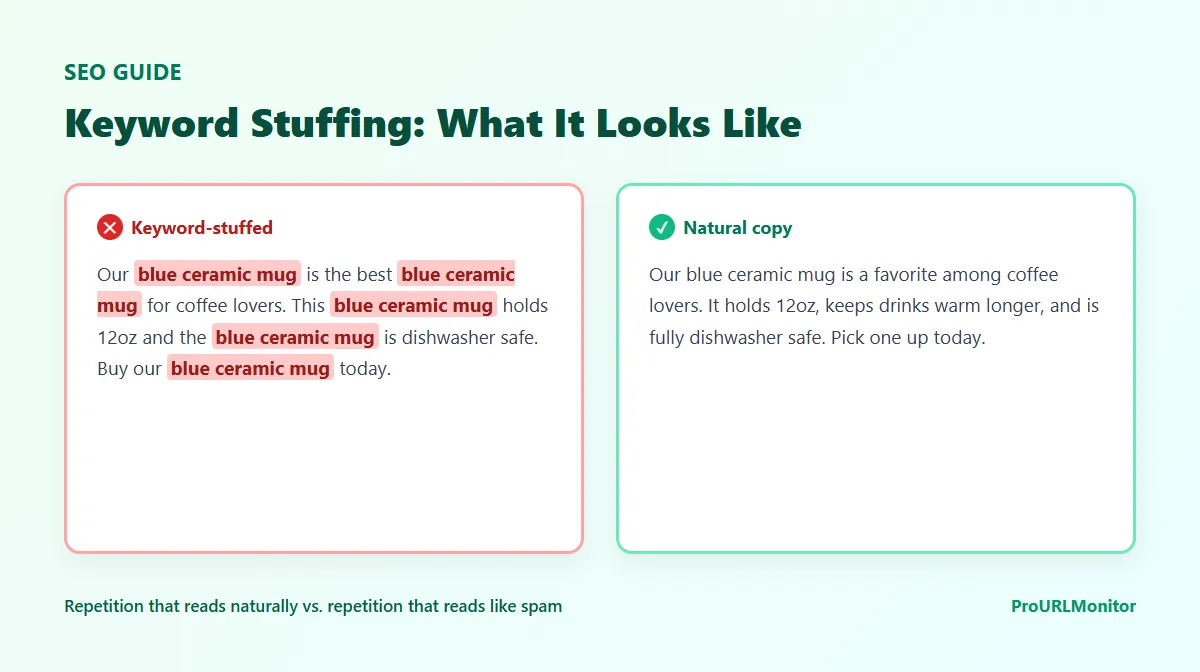
Unnatural repetition within a paragraph. A paragraph about, say, a fictional "blue ceramic mug" that mentions "blue ceramic mug" in nearly every sentence, even where a pronoun or a simpler phrase would read more naturally:
"Our blue ceramic mug is the best blue ceramic mug for coffee lovers. This blue ceramic mug holds 12oz and the blue ceramic mug is dishwasher safe. Buy our blue ceramic mug today."
Read it out loud and it's obvious - a human writing about their own product wouldn't repeat the exact same four words that many times in four sentences.
City and location stuffing. A page for a fictional plumbing business that appends a long, undifferentiated list of place names purely to try to rank for each one:
"We provide plumbing services in Springfield, Springfield plumbing, plumbers near Springfield, Springfield emergency plumbing, Springfield pipe repair, Springfield plumbing company, plumbing Springfield area..."
This is one of the examples Google's spam policies call out directly - blocks of text listing cities and regions a page wants to rank for, without providing any real information about the business in each one.
Synonym or variant stacking. Cramming every close variant of a term into a single sentence instead of choosing the one that reads best:
"Our SEO tools, search engine optimization software, SEO software, SEO analysis tools, and SEO checker tools help you rank."
A natural version would pick the term that fits the sentence and let the others appear elsewhere in the content where they belong.
Repeated headings. Using the same exact keyword phrase for a page's H1 and then again, unchanged, in most of its H2s and H3s, even where a more specific, descriptive heading would serve the reader better. Headings should describe what a section actually covers - if every heading on a page is a slight rearrangement of the same three words, that's a sign the structure was built for a keyword rather than for the content.
Hidden text. An older, more deceptive tactic: placing keyword lists in text that's invisible to visitors (white text on a white background, font-size: 0, or text positioned off-screen) so only crawlers "see" it. This is explicitly deceptive and is one of the more clear-cut manipulation patterns search engines look for - it's mentioned here only so you recognize it, not as a technique to consider.
None of these patterns are worth using even temporarily. They're easy for a human reader to spot, and that's exactly why they're also easy for a search engine's spam-detection systems to flag.
Why Keyword Stuffing Is Bad for SEO
It reads badly, which costs you readers before it costs you rankings. Content that repeats the same phrase unnaturally is harder to read and less trustworthy. A visitor who lands on stuffed copy is more likely to bounce immediately, and that behavior itself is a bad signal regardless of anything an algorithm detects directly.
It's explicitly covered by Google's spam policies. Keyword stuffing isn't a gray area - it's named directly in Google's search spam policies as a manipulative practice. Pages that show clear, severe patterns of it can be devalued by Google's automated systems, and in more serious or repeated cases, can receive a manual action from Google's search quality team, which is applied by a person reviewing the site rather than an algorithm alone.
It doesn't actually help you rank for more, or more relevant, searches. The theory behind stuffing was always that packing in more instances of a term (or every conceivable variant of it) would help a page rank for more queries. Modern search systems evaluate context, phrasing, and how well content actually answers a query - not how many times a string of characters appears verbatim. A well-written paragraph that mentions a topic naturally two or three times typically communicates relevance more clearly than the same paragraph with the term crammed in ten times.
It signals low effort more broadly. Stuffed content is frequently thin in other ways too - written to hit a keyword quota rather than to thoroughly answer a question. Even where stuffing itself doesn't trigger a specific penalty, the surrounding low-quality content often underperforms on its own.
None of this means you should avoid your target keyword. It means the repetition needs to serve the sentence, not the other way around.
How to Avoid Keyword Stuffing
Write for the person asking the question, not the algorithm reading the page. Start from what someone searching the term actually wants to know, and let the keyword appear wherever it naturally belongs in answering that.
Use your terms naturally, not on a schedule. There's no quota to hit. Mention your primary term where it's the clearest way to refer to the subject, and let pronouns, synonyms, and simpler phrasing carry the rest of the sentence the way they would in any other writing.
Avoid chasing an arbitrary density target. There's no official percentage Google looks for. Writing to hit a specific density number is one of the most common ways well-intentioned content drifts into stuffing - the target itself encourages unnatural repetition.
Vary your language where it's natural to do so. Synonyms, related terms, and simpler references (like "it" or "the product" instead of the full keyword phrase every time) keep writing readable without losing the topic.
Read repetitive sentences back and cut what doesn't earn its place. If a sentence only exists to repeat a keyword, either rewrite it to say something the previous sentence didn't, or remove it.
Check headings and metadata the same way you check body copy. A heading that repeats the exact keyword phrase used in three other headings on the same page usually means the headings aren't actually describing different sections - rewrite them to reflect what each part covers.
Review the finished draft before publishing, specifically for repetition. It's much easier to spot unnatural repeats in a finished piece than while you're writing it. This is also the point where running the content through a checker is genuinely useful.
How to Check Keyword Repetition
The fastest way to catch keyword stuffing before you publish is to paste your draft into a Keyword Density Checker. ProURLMonitor's free version counts single-word frequency and density, and it separately surfaces repeated two-word phrases, so you can see both which individual words are showing up most and which exact phrases are recurring.
It won't tell you whether content is "stuffed" - that judgment depends on context, since even a naturally written article can show a high density for a genuinely central topic term. What it does is surface which words and phrases are repeating most, so you can read those specific spots in context and decide whether the repetition still sounds natural. Treat it as a diagnostic that points you at the right paragraphs to review, not as a pass/fail score.
Keyword Density vs Keyword Stuffing
It's worth being precise about how these two terms relate, since they're often used as if they're interchangeable.
Keyword density is a measurement: the number of times a term appears divided by the total word count, expressed as a percentage. It's descriptive and mechanical - a calculator produces the same number regardless of whether the writing is good or bad.
Keyword stuffing is a judgment about whether that repetition reads as manipulation rather than normal topical coverage. It's entirely possible for a short, natural paragraph about a specific product to show a comparatively high density for that product's name, without being stuffed - because the repetition still reads naturally in context. It's also possible for content to feel stuffed well before hitting any particular density number, if the repetition is placed awkwardly or forced into sentences where it doesn't belong.
In short: density is the number, stuffing is the verdict a human reader reaches when that number (or the placement behind it) stops feeling natural. For the full breakdown of how density is calculated and whether it factors into rankings at all, see What Is Keyword Density?
Common Keyword Stuffing Mistakes
Treating a density percentage as a target to hit. As soon as a specific number becomes the goal, the writing tends to bend around it rather than the other way around.
Repeating a phrase to "reinforce" it for search engines. Modern ranking systems evaluate context and meaning, not raw repeat counts - repeating a phrase doesn't reinforce anything for the algorithm, it just makes the writing worse for the reader.
Stacking synonyms instead of choosing one. Listing every variant of a term back to back ("SEO tool, SEO software, SEO checker, SEO analyzer") in a single sentence reads as a keyword list, not a sentence.
Forcing a keyword into a heading that doesn't need it. Headings exist to help readers scan a page. A heading that exists only to repeat a keyword, rather than describe the section beneath it, fails at that job.
Copy-pasting a template paragraph across many near-identical pages (for example, swapping in a different city name each time) rather than writing something genuinely specific to each page. This is effectively location stuffing spread across a whole site instead of a single page.
Assuming more mentions always helps. Past a certain point, additional repetitions of the same term add nothing - the content isn't communicating anything new, it's just getting longer and harder to read.
FAQs
What is keyword stuffing?
Keyword stuffing is loading a page with keywords or phrases in an attempt to manipulate search rankings, often to the point that the repetition sounds unnatural or the terms are dropped in out of context. Google's search spam policies list it explicitly as a manipulative practice, alongside things like lists of phone numbers with no added value or blocks of text naming every city a page wants to rank for.
Is keyword stuffing bad for SEO?
Yes. Google's spam policies define keyword stuffing as a manipulative practice that can lead to lower rankings or a manual action, and unnatural repetition also drives away human readers regardless of what an algorithm does. It rarely helps a page rank and it routinely hurts both trust and readability.
What are examples of keyword stuffing?
Common patterns include repeating the exact same phrase in nearly every sentence, appending long lists of city or region names to a page that isn't really about any of them, listing awkward strings of synonyms back to back, and stacking a keyword into a heading multiple times in a row. The common thread is that the repetition serves the algorithm instead of the reader.
How do I know if my content has keyword stuffing?
Read a paragraph out loud. If a phrase repeats often enough that it sounds robotic, or a sentence only makes sense because a keyword was forced into it, that's a sign of stuffing. A keyword density checker can also surface which terms are repeating unusually often so you can review them in context.
Does Google penalize keyword stuffing automatically?
Google's systems can devalue pages that show clear manipulation patterns like keyword stuffing, and severe or repeated cases can also result in a manual action from Google's search quality team. Either way, the practical effect is the same: the page is less likely to rank well than a naturally written equivalent.
What's the difference between keyword stuffing and keyword density?
Keyword density is a neutral measurement - the percentage of a keyword's occurrences relative to total word count. Keyword stuffing is a judgment about how that repetition reads: it's the point where density stops reflecting normal topical coverage and starts reading as manipulation. A page can have a specific density number without being stuffed, and stuffed content doesn't always trip a single fixed percentage.
How can I check my content for keyword stuffing?
Paste your content into a keyword density checker to see which words and phrases repeat most often, then read the highest-frequency terms in context. ProURLMonitor's free Keyword Density Checker shows word and two-word phrase frequency so you can spot repetition that needs editing before you publish.
Try Our Free SEO Tools
Put what you learned into action with our free SEO analysis tools.