What Is Keyword Density? Formula, SEO Impact & Examples
Keyword density is the percentage of times a word or phrase shows up in a piece of content compared to the content's total word count. It's a simple calculation, but it's also one of the most misunderstood numbers in SEO - treated by a lot of older advice as a formula for rankings, when it's really just a description of how often a term repeats.
This guide covers what the number actually is, how to calculate it correctly (including for multi-word phrases), and what Google has actually said about whether it affects rankings at all.
What Is Keyword Density?
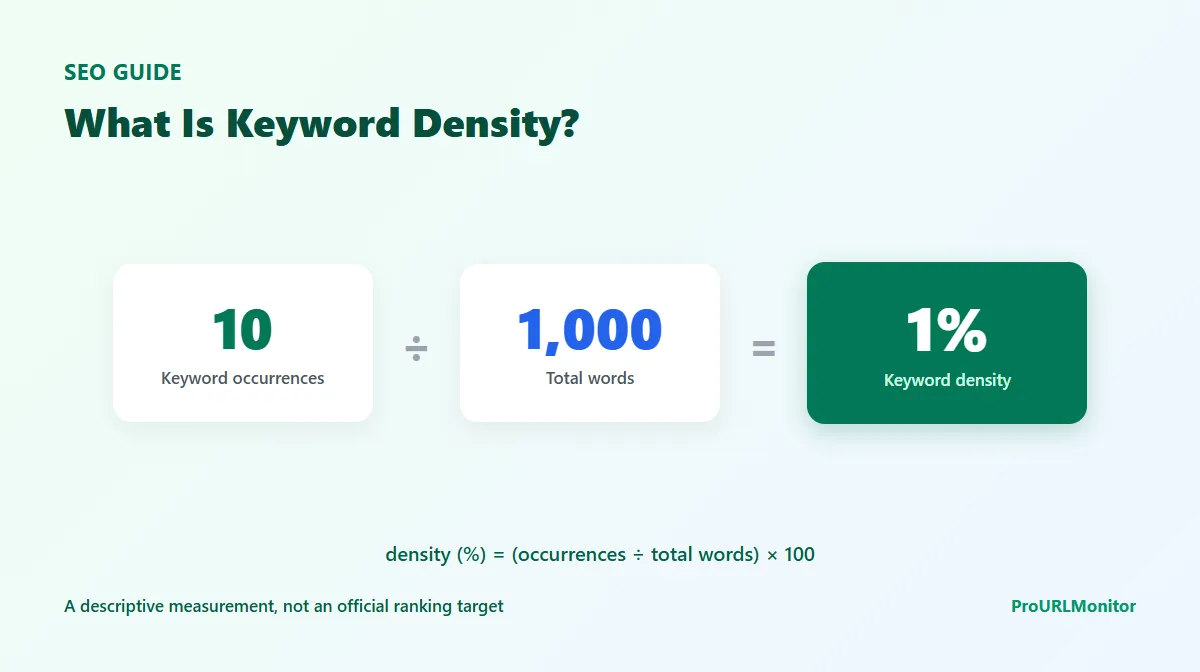
Keyword density measures how often a specific keyword appears in a piece of content, expressed as a percentage of the total word count. If an article is 1,000 words long and its target keyword appears 10 times, that keyword's density is 1%.
That's the entire concept. It's a ratio, not a rule. Nothing about the number itself tells you whether content is well-written, thin, or manipulative - it just tells you how often a term repeats relative to how much content surrounds it.
How to Calculate Keyword Density
For a single-word (or exact-phrase) keyword, the formula is:
Keyword density (%) = (keyword occurrences ÷ total word count) × 100
To use it:
- Count how many times the exact keyword appears in the content.
- Count the content's total word count.
- Divide the occurrence count by the total word count.
- Multiply by 100 to get a percentage.
For multi-word phrases, the same underlying idea applies, but there's no single universal denominator that every tool uses. Some calculators divide phrase occurrences by the total word count, treating the phrase like a single unit. Others divide by the total number of possible phrase-length windows in the text - for a two-word phrase, that's the total word count minus one, since a text of n words contains n − 1 adjacent word-pairs. Both are defensible; they just answer slightly different questions ("how much of the content is this phrase" versus "of all possible two-word windows, how many are this phrase"). If you're comparing density numbers between two different tools, check which method each one uses before assuming the numbers mean the same thing.
Keyword Density Formula Example
Here's a worked example, checked for accuracy:
- Article length: 1,000 words
- Target keyword: appears 10 times
- Density = (10 ÷ 1,000) × 100 = 1%
A second example, for a shorter piece:
- Article length: 300 words
- Target keyword: appears 6 times
- Density = (6 ÷ 300) × 100 = 2%
Notice that the second example has a higher density despite using the keyword fewer times in absolute terms - because the total word count is much smaller. This is the main reason density numbers can't be compared across content of very different lengths without context: a short page will naturally show a higher density than a long page for the same number of mentions.
For a two-word phrase, using the "total possible windows" method: if a 500-word article contains the two-word phrase "keyword density" 5 times, the density would be (5 ÷ 499) × 100 ≈ 1.00%, since a 500-word text contains 499 adjacent word pairs.
Does Keyword Density Matter for SEO?
This is the part most articles on this topic get wrong, so it's worth being precise.
Google does not use keyword density as a ranking formula. Google's John Mueller has said directly, in Search Central Q&As over roughly the past decade, that keyword density isn't a concept Google's ranking systems evaluate - there's no internal "optimal density" target that content is measured against. Google's search spam policies confirm the flip side of this: keyword stuffing is defined by whether repetition reads as unnatural manipulation, not by crossing a specific percentage. Neither document describes a target density to aim for.
Is there an ideal or "good" keyword density, then? No official one. Percentages like "1-2%" or "0.5-2.5%" that circulate across SEO blogs and tools are informal rules of thumb, not figures Google has published or endorsed. Treat any source that states a specific percentage as an official Google target with real skepticism - it's a claim that isn't backed by Google's own documentation.
So why does density still get mentioned as an SEO concept at all? Because it can be a useful descriptive diagnostic, even without being a ranking lever. A piece of content that never mentions its subject probably isn't thorough enough to rank well - not because it missed a density target, but because it likely doesn't answer the query in enough depth. On the other end, a density high enough to make the writing sound repetitive is worth a second look, not because it crosses a magic number, but because unnatural repetition is exactly what keyword stuffing looks like. Density is a signal you can use to prompt a manual review of your own writing - it's not a metric to optimize toward directly.
Does keyword density matter, in short? Not as a ranking formula, no. As a quick way to sanity-check whether your content mentions its topic a reasonable number of times, and whether any particular phrase is repeating so often it needs editing, yes - it's a useful editorial tool. The mistake isn't using the number; it's treating it as a target percentage instead of a diagnostic.
What Is Keyword Density in SEO?
It helps to separate two different things that get blended together under "keyword density in SEO":
- Density as a measurement. A neutral number produced by a formula, unrelated to how good the content is.
- Density as an (imagined) ranking formula. The idea, popular in early-2000s SEO, that hitting a specific percentage would directly improve rankings. This version isn't supported by anything Google currently publishes, and Mueller's comments directly contradict it.
When you see "keyword density" discussed in an SEO context, it's worth asking which of these two things is actually being claimed. The measurement is real and simple to calculate. The ranking formula is the part that doesn't hold up.
Keyword Density vs Keyword Frequency
These two terms are related but not identical:
- Keyword frequency is the raw count - how many times a term appears, full stop. It has no built-in sense of scale: "12 times" means something very different in a 200-word page versus a 4,000-word page.
- Keyword density takes that same count and relates it to the content's total length as a percentage, which makes it possible to compare repetition across content of different sizes.
In practice, frequency is the input and density is the derived, more comparable output. A tool that reports both is giving you the raw count (frequency) and the scaled version of it (density) side by side.
How to Check Keyword Density
The quickest way to calculate this for your own content is to paste it into a Keyword Density Checker. ProURLMonitor's free version reports total and unique word counts, then lists your most frequent single words and two-word phrases along with each one's density percentage, so you can see both the raw frequency and the scaled number without doing the math by hand.
Use the result the way this article recommends: as a way to spot which terms are repeating most, not as a score to push toward a specific percentage.
Keyword Density and Keyword Stuffing
Density and stuffing are frequently confused, but they're not the same thing. Density is the number; stuffing is the judgment call about whether that number - or more precisely, the writing behind it - reads as manipulative repetition rather than natural coverage of a topic. Content can carry a comparatively high density for its central subject without being stuffed, if the repetition still reads naturally. For the full picture, including real examples of what stuffing looks like and how to avoid it, see Keyword Stuffing: What It Is, Examples & How to Avoid It.
Common Keyword Density Mistakes
Treating a percentage as a pass/fail target. As covered above, no such official target exists - writing to hit one usually makes content worse, not better.
Comparing density numbers across very different content lengths without context. A 300-word page and a 3,000-word page will show very different densities for the same topic, simply because of the denominator - that difference doesn't mean one page is better optimized than the other.
Assuming every tool calculates multi-word phrase density the same way. As shown above, tools can reasonably use different denominators for phrases. Compare density numbers within the same tool, not across different tools, unless you've confirmed they use the same method.
Ignoring context when a term repeats often. A high density isn't automatically a problem - read the actual sentences before deciding anything needs to change.
Forgetting that density says nothing about quality. A page can hit any density number and still fail to actually answer the query it's targeting. Density measures repetition, not usefulness.
FAQs
What is keyword density?
Keyword density is the percentage of times a specific word or phrase appears in a piece of content relative to the content's total word count. It's calculated as (keyword occurrences ÷ total words) × 100, and it's a descriptive measurement, not an official Google ranking signal.
How do you calculate keyword density?
Divide the number of times a keyword appears by the total word count of the content, then multiply by 100. For example, a keyword that appears 10 times in a 1,000-word article has a density of (10 ÷ 1,000) × 100 = 1%.
Is there an ideal or good keyword density for SEO?
No official one. Google's John Mueller has said keyword density isn't something Google's ranking systems evaluate, and Google's spam policies judge repetition by whether it sounds natural, not by a percentage. Percentages like 1-2% that circulate online are informal community rules of thumb, not Google-endorsed targets.
Does keyword density affect Google rankings?
Not as a direct ranking formula. Google has stated keyword density isn't a factor its systems use to evaluate content. What does matter is whether content thoroughly and clearly covers what a searcher is looking for - density can reflect that indirectly, but hitting a specific number doesn't cause a ranking improvement on its own.
What's the difference between keyword density and keyword frequency?
Frequency is the raw count of how many times a keyword appears - just a number, with no context. Density relates that count to the content's total length as a percentage, which makes it possible to compare repetition across pieces of content with different word counts.
How is keyword density calculated for multi-word phrases?
The same core idea applies - occurrences of the phrase relative to the content's size - but tools differ on the exact denominator. Some divide by total word count, others divide by the total number of possible phrase-length windows in the text (for a two-word phrase, that's total words minus one). Check how a specific tool defines it before comparing numbers across tools.
Can keyword density be too high?
There's no official cutoff, but a density that's high enough to make the writing sound repetitive is a sign worth investigating - that's the point where density can shade into keyword stuffing. Read the sentences around a high-frequency term to judge whether the repetition is doing something for the reader or just inflating a count.
Try Our Free SEO Tools
Put what you learned into action with our free SEO analysis tools.