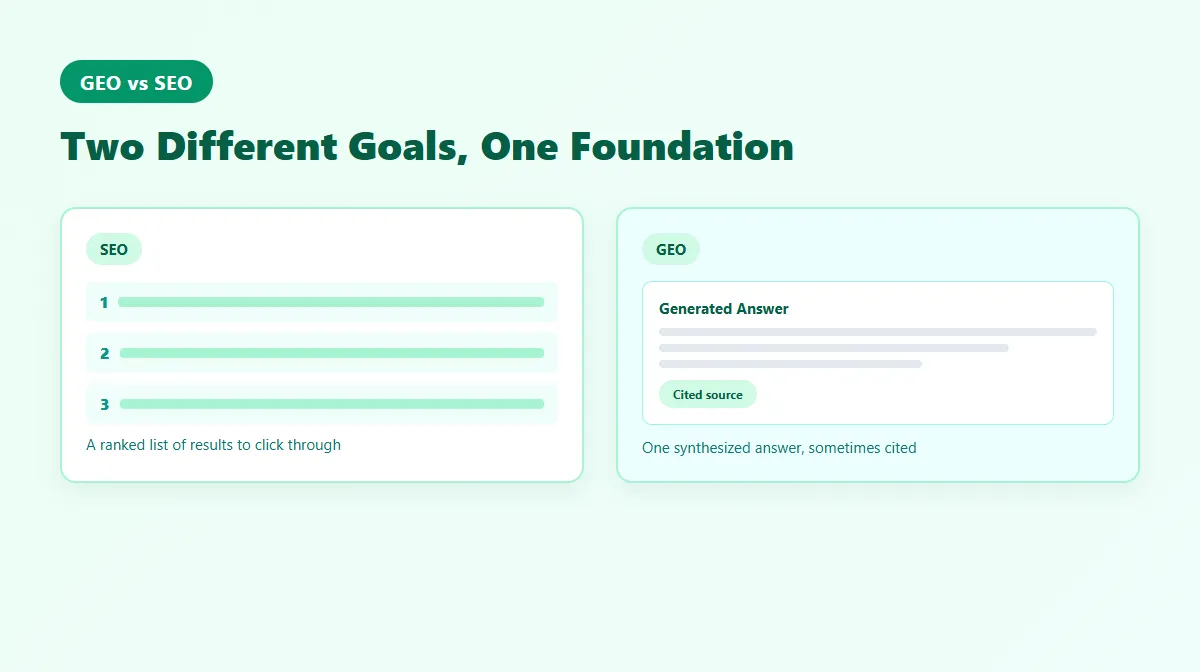
GEO vs SEO: What's the Difference?
GEO (Generative Engine Optimization) and SEO (Search Engine Optimization) optimize for different outcomes: SEO earns a ranking position in a list of search results a person scans and clicks. GEO earns a spot inside an AI-generated answer, which synthesizes information from multiple sources into one response — often without requiring a click at all.
They share a foundation — crawlable pages, topical relevance, credible sourcing — but they diverge in what "success" looks like and how you measure it.
GEO vs SEO: Quick Comparison
| SEO | GEO | |
|---|---|---|
| Primary environment | Traditional search results pages | AI-generated answers (chat platforms, AI search features) |
| Goal | Rank as high as possible in a list of results | Be selected, synthesized, and ideally cited in a generated answer |
| Typical result format | A list of links with titles and descriptions | A single written answer, sometimes with source citations |
| Discovery mechanism | Crawling and indexing by a search engine | Retrieval by a generative system, often grounded in a search index |
| Citations | Not part of the format — users click through instead | Central to some platforms; absent or inconsistent on others |
| Content strategy | Keyword-targeted pages built around search intent | Clear, directly extractable answers with strong topical depth |
| Measurement | Search Console, rank trackers — mature, standardized tooling | No standardized tooling; mostly manual observation today |
| Technical foundation | Crawlability, indexability, page speed, structured data | Same technical foundation, plus content structured for extraction |
What Is SEO?
SEO is the practice of optimizing a website so it ranks well in traditional search engine results — think Google's list of ten blue links. It covers technical factors (crawlability, page speed, indexability), content factors (relevance, depth, keyword targeting), and authority factors (backlinks, reputation). Success is measured by ranking position, organic traffic, and click-through rate.
What Is GEO?
GEO is the practice of optimizing content so generative AI systems — ChatGPT, Google Gemini, Perplexity, and similar tools — can retrieve it, understand it, and use it when composing an answer, ideally with attribution. Instead of competing for a ranking position, GEO content competes to become part of the answer itself. For a full breakdown of how this works, see our guide on Generative Engine Optimization.
Key Differences Between GEO and SEO
- Outcome: SEO produces a ranked link; GEO produces (or contributes to) a synthesized answer.
- User behavior: SEO assumes the user clicks through to your page. GEO often ends the search entirely inside the AI's answer, with no click.
- Format: SEO rewards a well-structured full page. GEO rewards specific passages that can be lifted out cleanly, in addition to overall page quality.
- Attribution: SEO gets no in-line "citation" — ranking is the reward. GEO citations, where platforms provide them, function more like a compressed, AI-mediated backlink.
- Feedback loop: SEO has decades of tooling and a shared understanding of ranking signals. GEO is new enough that measurement is largely manual, and no platform has published a definitive ranking methodology.
What GEO and SEO Have in Common
The overlap is bigger than the differences:
- Crawlability and indexability are non-negotiable for both — content that can't be crawled can't be ranked or retrieved.
- Topical authority helps in both contexts — a site that consistently covers a subject well is more likely to rank and to be trusted as a source by a generative system.
- Credible sourcing and factual accuracy matter to search engines and generative AI systems alike.
- Structured content (headings, lists, tables) helps both classic search snippets and AI extraction.
This overlap is exactly why most GEO guidance describes it as an additional layer on top of SEO, not a separate discipline built from scratch.
Does GEO Replace SEO?
No. Traditional search still drives a substantial share of how people find information, and generative AI systems frequently rely on the same underlying search infrastructure and ranking signals to decide what to retrieve and trust in the first place. Google has stated that many of the core SEO best practices that apply to standard search results also apply to its own generative AI features. Removing SEO investment on the assumption that GEO has replaced it would cut off one of the inputs GEO itself depends on.
How to Use SEO and GEO Together
- Keep the SEO foundation solid. Crawlable architecture, fast pages, clean indexing, and topical depth remain the baseline both strategies need.
- Add GEO-specific structuring on top. Lead sections with direct answers, use question-shaped headings, and include tables or lists for anything comparative.
- Don't duplicate content for each channel. The same well-structured page usually serves both a search engine crawler and a generative AI retriever — you're adjusting structure and clarity, not writing two versions.
- Track both, separately. Because measurement methods differ (see below), report on SEO and GEO as related but distinct metrics rather than trying to combine them into a single number.
How to Measure SEO vs GEO Performance
SEO measurement is mature: Google Search Console reports impressions, clicks, and average position for the queries your pages rank for. Rank-tracking tools extend that further.
GEO measurement is not mature. No major AI platform currently offers a public, standardized report of when your content was retrieved, mentioned, or cited in a generated answer. In practice, most teams track GEO performance by manually recording observations: run a set of representative prompts against the platforms your audience actually uses, and note whether your brand appeared and whether it was cited.
ProURLMonitor's AI Search Ranking Checker supports exactly that workflow — it generates the queries and platform links, and you record what you see across ChatGPT, Perplexity, Gemini, Bing Copilot, and Claude, then it calculates a visibility score from your own recorded observations. It does not query these platforms automatically. For more on what AI visibility measurement can and can't currently do, see What Is AI Search Visibility?
Frequently Asked Questions
Is GEO better than SEO?
Neither is universally "better" — they optimize for different outcomes. SEO earns a ranking position and a click. GEO earns inclusion in an AI-generated answer, which may or may not produce a click. Which matters more depends on where your audience is actually searching.
Can you do GEO without SEO?
Not effectively. Generative AI systems still rely on many of the same signals search engines use to decide what's crawlable, relevant, and trustworthy. A page with no organic visibility and no technical SEO foundation is unlikely to be retrieved or trusted as a source, regardless of how well it's written for extraction.
Does GEO replace SEO?
No. Search engines still drive a large share of information discovery, and organic visibility remains one of the inputs generative AI systems use when deciding what to trust. Most teams treat GEO as an added layer of strategy, not a replacement for existing SEO work.
What's the biggest practical difference between GEO and SEO?
Measurement. SEO has mature, standardized tools — Google Search Console shows rankings, impressions, and clicks. GEO doesn't have an equivalent: no AI platform currently publishes standardized data on when your content was used, mentioned, or cited in a generated answer.
Should I create separate content for GEO and SEO?
Usually not. The core practices — clear answers, strong topical coverage, credible sourcing, crawlable pages — serve both. Most teams adjust formatting and structure (leading with direct answers, adding structured comparisons) rather than writing entirely separate content for each.
How do I measure GEO and SEO performance together?
Track them side by side rather than trying to merge them into one score. Use Search Console (or a rank tracker) for organic SEO performance, and a manual AI-visibility check for GEO performance. ProURLMonitor's AI Search Ranking Checker is built for the second half of that — recording your own observations across AI platforms and calculating a visibility score from them.
Try Our Free SEO Tools
Put what you learned into action with our free SEO analysis tools.