Generative Engine Optimization (GEO): What It Is & How It Works
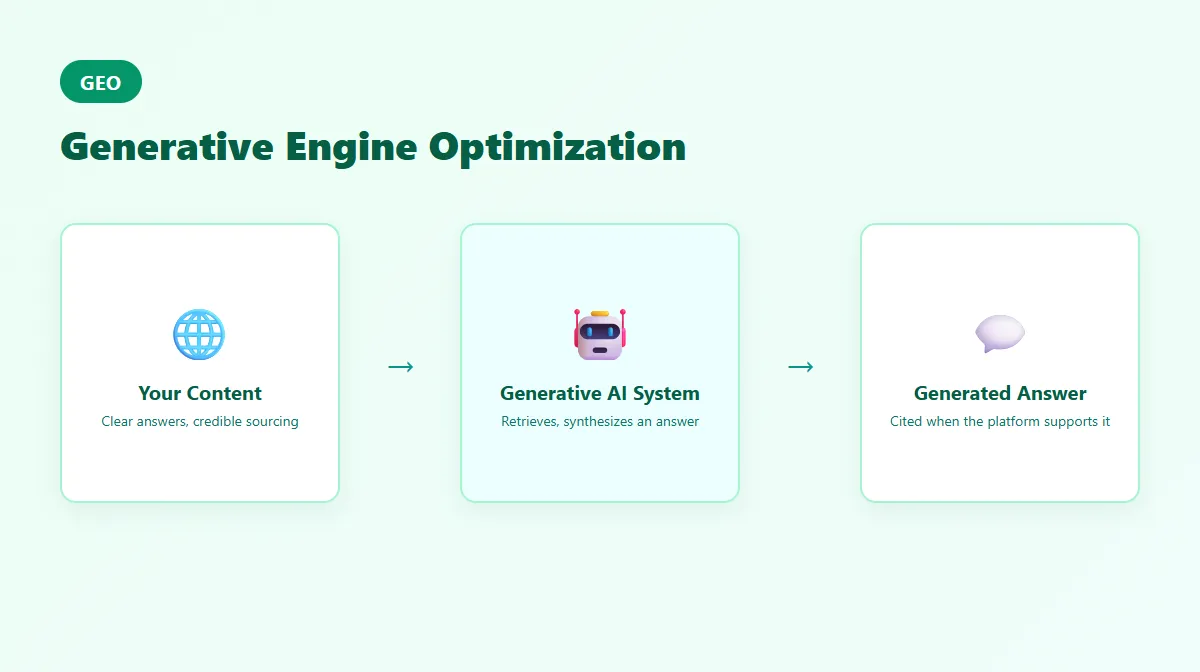
Generative Engine Optimization (GEO) is the practice of structuring and strengthening content so generative AI systems — chatbots and AI-powered search tools like ChatGPT, Google Gemini, and Perplexity — can find it, understand it, and use it when they generate an answer, ideally with a citation back to the source.
The term describes a real shift in how people find information. Instead of scanning a list of ten blue links, a growing share of searches now end with a single synthesized answer that pulls from several sources at once. GEO is the set of practices aimed at making sure your content is one of the sources an AI system chooses to use.
What Is Generative Engine Optimization?
GEO is the AI-search counterpart to SEO. Where SEO optimizes a page to rank well in a results list, GEO optimizes content to be retrieved, understood, and referenced by a generative AI system while it composes an answer.
The term originated in academic research on how content influences visibility in generative search systems, and it has since become the common industry label for this practice — alongside the closely related term AEO (Answer Engine Optimization), which we cover in a separate guide. The two terms overlap heavily in practice; see our GEO vs AEO comparison if you're trying to decide which label fits your work.
A useful way to frame the goal: SEO tries to earn a click. GEO tries to earn a place inside the answer itself, whether or not that produces a click.
How Does GEO Work?
Generative AI systems that answer questions from live or indexed web content generally follow a version of this process:
- Retrieval — the system searches an index or the live web for content relevant to the user's question.
- Source selection — it evaluates which retrieved pages are relevant, credible, and useful enough to draw from.
- Synthesis — it extracts and combines information from the selected sources into a single answer.
- Attribution (where supported) — some systems cite or link back to the sources they used; others summarize without a visible citation.
This pattern is often called retrieval-augmented generation (RAG), or "grounding" — a technique used to improve the accuracy and freshness of an AI-generated response by anchoring it to retrieved documents rather than relying only on what the model already "knows." Google has described its own AI Overviews and AI Mode as using a version of this approach, built on its Search index.
GEO is the practice of making each of those four steps more likely to go in your favor: being retrievable, being selected, being represented accurately during synthesis, and — where the platform supports it — being credited.
GEO vs Traditional SEO
GEO and SEO share the same foundation — content needs to be crawlable, relevant, and trustworthy either way — but they optimize for different outcomes.
| SEO | GEO | |
|---|---|---|
| Primary goal | Rank in a list of results | Be selected and used inside a generated answer |
| Typical result | A list of links a user scans and clicks | A single synthesized answer, sometimes with citations |
| Success signal | Ranking position, click-through rate | Appearing, being cited, or being mentioned in an answer |
| Content strategy | Keyword-targeted pages built around search intent | Clear, directly extractable answers plus strong topical depth |
| Measurement | Search Console, rank tracking | No universal metric — mostly manual or platform-specific observation |
This is a deliberately short summary — for the full breakdown, including where the two strategies genuinely conflict and where they reinforce each other, see our dedicated guide: GEO vs SEO.
How AI Search Engines Find and Use Information
Generative AI systems don't use one universal, publicly documented ranking algorithm the way search engines publish general guidance about theirs. What's consistently observed and documented across platforms is a set of underlying mechanics:
- Retrieval depends on the same basics that make a page findable at all: it has to be crawlable, indexed somewhere the system can access, and relevant to the query.
- Source selection favors content that answers the question clearly, without requiring the reader (or the AI) to infer the point from surrounding fluff.
- Citations tend to go to content that states specific, verifiable facts — a number, a named source, a direct quote — rather than vague generalizations.
- Entity understanding matters: AI systems build an internal sense of who or what a page is about (a company, a product, a person), and consistent, unambiguous naming helps that understanding stay accurate across sources.
- Content usefulness to the specific question being asked matters more than overall site size or page count — a single page that answers a question precisely can outperform a much larger site that only addresses it indirectly.
None of this amounts to a fixed checklist that guarantees inclusion. Treat it as the direction the evidence points, not a formula.
Core GEO Principles
Based on how generative AI systems are documented to retrieve and use content, these are the practices that show up consistently across GEO guidance:
- Clear, direct answers. State the answer to the likely question early and plainly, rather than building up to it.
- Strong topical coverage. Depth on a subject — not just a single page, but a body of related content — helps establish that a site is a credible source on the topic.
- Entity clarity. Use consistent names for your brand, product, and key terms so AI systems can confidently connect mentions of you across different sources.
- Authoritative sourcing. Back claims with credible references, and be citable yourself — original data, named experts, and dated information all help.
- Crawlability and indexability. None of the above matters if the content isn't accessible to crawlers in the first place. This is a technical SEO requirement GEO cannot skip.
- Structured content. Headings, lists, and tables make it easier for a system to extract a specific fact or answer without needing the surrounding narrative.
- Original information. Content that only restates what's already been said elsewhere gives a generative system less reason to select it over an existing, already-trusted source.
- Consistent signals over time. A single well-optimized page is weaker evidence than a site that repeatedly demonstrates accuracy and relevance on a topic.
These are widely recommended practices based on how generative retrieval is documented to work — not a confirmed, universal ranking algorithm, and no platform has published one.
How to Optimize Content for Generative Search
In practice, applying the principles above looks like:
- Lead with the answer. Put a direct, specific answer to the core question in the first few sentences of a section, then expand with supporting detail.
- Use descriptive headings. A heading like "How Does GEO Work?" is easier for a retrieval system to match to a user's question than a vague one like "Overview."
- Add tables and lists for comparisons. Structured formats are easier to extract a specific fact from than dense paragraphs.
- Cite real, checkable sources. Link to primary documentation, official guidance, or original data instead of restating secondhand claims.
- Keep content current. Update dates, figures, and examples when they change — generative systems favor accurate, current information over stale pages that happen to rank well historically.
- Maintain the technical basics. Confirm your important pages are indexable, load reliably, and aren't blocked from crawlers — GEO fails immediately if a page can't be retrieved.
How to Measure GEO Performance
This is the part of GEO with the least mature tooling. Unlike organic SEO, where Google Search Console gives you impressions, clicks, and average position, no AI platform currently offers a standardized, public API for "how often was my brand cited or mentioned."
In practice, most teams fall back on structured manual observation: pick a set of representative prompts, run them against the AI platforms that matter to your audience, and record whether your brand appeared, was mentioned by name, or was cited with an attributed source. Repeating this on a regular cadence turns a one-time snapshot into a trend.
ProURLMonitor's AI Search Ranking Checker is built around exactly this manual workflow — it generates the domain-and-keyword queries and platform links for you, and you record what you observe, then it calculates a visibility score from those recorded observations. It does not query ChatGPT, Perplexity, Gemini, or any other platform automatically. For a deeper look at what "AI visibility" can and can't currently measure, see What Is AI Search Visibility?
GEO Mistakes to Avoid
- Chasing GEO while ignoring basic SEO. If a page isn't crawlable or indexed, no amount of GEO-specific formatting will help — retrieval fails before optimization ever gets evaluated.
- Optimizing for keywords instead of questions. GEO responds better to content organized around the actual questions people ask than to keyword-stuffed pages built around a phrase.
- Treating one AI platform's behavior as universal. ChatGPT, Gemini, and Perplexity retrieve and cite differently; content that performs well in one doesn't automatically perform the same in another.
- Assuming a citation is guaranteed. Even strong, well-sourced content is sometimes summarized without a visible citation — this is a platform behavior, not necessarily a content failure.
- Inventing or copying "ranking factors" as fact. No generative AI platform has published a definitive ranking algorithm. Treat any specific claimed factor — including the ones in this guide — as observed practice, not confirmed mechanics.
Frequently Asked Questions
What does GEO stand for?
GEO stands for Generative Engine Optimization: the practice of structuring and strengthening content so generative AI systems — chatbots and AI search tools like ChatGPT, Gemini, and Perplexity — can find it, understand it, and use it (often with a citation) when they synthesize an answer.
Is GEO different from SEO?
Yes, though they share a foundation. SEO is built around ranking a page in a list of results a person clicks through. GEO is built around a page's information being selected, summarized, and often credited inside an AI-generated answer, where there may be no click at all. See our dedicated guide on GEO vs SEO for a full comparison.
Is GEO worth prioritizing right now?
For most sites, yes as an incremental addition rather than a wholesale strategy shift. Since GEO measurement is still immature and no platform publishes a definitive ranking algorithm, the lowest-risk approach is applying GEO-friendly structure (direct answers, clear sourcing) to content you're already producing for SEO, rather than building a separate GEO-only content program.
How do I measure GEO performance?
There's no single, universal GEO metric, because AI platforms don't expose consistent ranking or citation data the way Google Search Console does for organic search. Most teams track it by manually or semi-manually recording whether their brand appears, is mentioned, or is cited across the AI platforms and prompts that matter to their business, then watching that pattern over time. See our guide on AI search visibility for a full breakdown of what can realistically be measured.
Which AI platforms does GEO apply to?
GEO commonly refers to optimizing for chat-style generative AI systems such as ChatGPT, Google Gemini, Perplexity, and Claude. Google's AI Overviews and AI Mode are also generative in nature, though Google has stated that the same core SEO practices that apply to standard Search also apply there — see our guide on Google AI Overview SEO for specifics.
What is the most important GEO principle?
No single factor guarantees inclusion in an AI-generated answer, but the practices that come up consistently across generative AI systems are: clear, directly-stated answers; strong topical coverage; verifiable facts with credible sourcing; and content that's actually crawlable and indexable in the first place. Content an AI system can't access or can't confidently verify is unlikely to be used regardless of how well it's written.
Try Our Free SEO Tools
Put what you learned into action with our free SEO analysis tools.