What Is AI Search Visibility & How Do You Measure It?
AI search visibility describes how often, and how favorably, a brand, product, or website shows up when people ask AI platforms — ChatGPT, Perplexity, Google Gemini, Bing Copilot, Claude, and similar tools — questions related to that brand's category. It's the AI-search equivalent of asking "where do we rank on Google," except the answer isn't a single number, and no platform currently reports it the way Google Search Console reports organic rankings.
What Is AI Search Visibility?
AI search visibility is a general concept, not a single standardized metric. It typically covers a few related but distinct signals:
- Presence — does your brand or site show up at all when a relevant question is asked?
- Mentions — is your brand named in the AI's answer, even without a link or source attribution?
- Citations — does the answer attribute a specific source (a link, footnote, or reference) to your site?
- Framing — when you do appear, is the mention positive, neutral, or unfavorable, and how does it compare to competitors mentioned in the same answer?
Different tools and teams weight these signals differently, which is part of why "AI visibility" doesn't reduce to one universally agreed-upon number.
What Does AI Brand Visibility Mean?
"AI brand visibility" is essentially the same concept applied specifically to brand-level presence rather than a single page or product. It asks: when someone asks an AI platform a category question — "best project management tools," "top accounting software for freelancers" — does your brand show up as part of the answer, and how does that compare to your competitors showing up in the same response?
AI Visibility vs Traditional Search Visibility
Traditional search visibility is well-defined and well-measured: a ranking position for a given keyword, tracked over time, with mature tools reporting impressions, clicks, and position. AI search visibility lacks that shared infrastructure. There's no universal "AI rank #3" the way there's a Google rank #3, because most generative AI answers don't present results as a numbered, comparable list — they synthesize a response that may name zero, one, or several sources without a formal ranking order.
That difference is exactly why AI visibility tracking today looks more like structured observation than automated rank tracking.
What Can Be Measured?
Realistically, with current tooling, the things you can measure fall into two categories:
Platform-native, first-party data (limited): Some platforms are starting to expose their own reporting. Google, for example, has extended Search Console with reporting for how a site performs within its own AI Overviews and AI Mode features specifically. This is genuinely useful, but it's scoped to that one platform — it doesn't tell you anything about ChatGPT, Perplexity, or Claude.
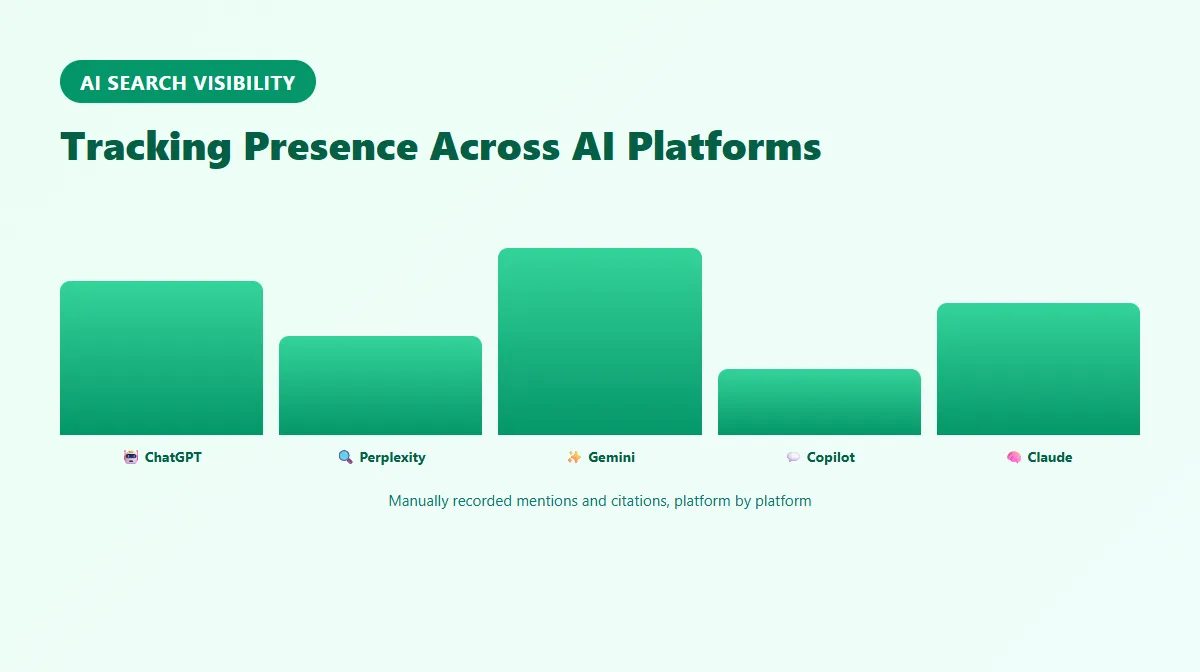
Cross-platform, manually recorded data: For visibility across multiple AI platforms at once, there is currently no standardized public API. The practical approach is to run a consistent set of representative prompts against each platform and record what you observe — whether your brand appeared, was mentioned by name, was cited with a source, and how it compared to competitors in the same answer.
Don't assume every platform exposes standardized metrics just because one does — as of this writing, Google is the notable exception with first-party reporting for its own AI search features, not the norm across the category.
What Is an AI Visibility Score?
There is no universal, industry-standard "AI visibility score." Different vendors and tools that offer one calculate it their own way, using their own weighting of presence, mentions, citations, and sometimes sentiment — which means a score from one tool is not directly comparable to a score from another unless you know both use the same formula.
ProURLMonitor's methodology, specifically, works like this: after you manually record whether your site "appeared" and was "cited" for each query and platform you check, the tool calculates a 0–100 score as:
Ranking Score = (queries marked "appeared" ÷ total checked queries) × 60
Citation Score = (queries marked "cited" ÷ total checked queries) × 40
AI Visibility Score = round(Ranking Score + Citation Score)
That's a deliberate weighting choice — appearing counts for more than being cited, but citations still meaningfully move the score — and it's entirely based on what you personally recorded. It is not derived from live API calls to any AI platform, and it is not an industry benchmark. Treat it as a way to quantify your own manual observations consistently over time, not as a score that can be directly compared against a different tool's number.
How to Measure AI Search Visibility Manually
A practical, repeatable process:
- Pick representative prompts. Include your brand name directly, plus category and problem-based questions your buyers would realistically ask (not just "[your brand] review").
- Choose the platforms that matter to your audience. ChatGPT, Perplexity, Gemini, Bing Copilot, and Claude behave differently — checking only one gives you an incomplete picture.
- Run each prompt and record what happens: did your brand appear? Was it named directly? Was a source cited? What competitors showed up in the same answer?
- Repeat on a consistent schedule so you're comparing snapshots over time, not a single one-off result.
ProURLMonitor's AI Search Ranking Checker is built around this exact workflow: it generates the domain-and-keyword queries and platform links for you, you open each platform and record your own observations, and it calculates the visibility score above from what you recorded. It does not query ChatGPT, Perplexity, Gemini, Copilot, or Claude automatically — you're the one doing the checking.
How to Improve AI Search Visibility
- Strengthen the underlying content, since generative systems still lean on the same authority and relevance signals as traditional search — see our guide on Generative Engine Optimization for the specifics.
- Make key facts easy to extract and cite: clear definitions, specific numbers, and named sources are more likely to be pulled into an answer than vague claims.
- Check category and comparison questions, not just brand-name searches — most buyers don't type your brand name first.
- Track competitors in the same checks so you know whether a low score reflects a market-wide pattern or something specific to your content.
How Often Should You Check?
Weekly or bi-weekly is reasonable for active campaigns; monthly is often enough for slower-moving categories. Keep expectations calibrated: AI-generated answers can vary between runs, models, and even individual accounts, so a single check is a snapshot, not a fixed, permanent measurement of your visibility.
Common Measurement Mistakes
- Treating one tool's score as an industry benchmark. Scores are only comparable within the same methodology.
- Checking only brand-name prompts. Category and problem-based prompts are often more representative of real buyer behavior.
- Confusing a mention with a citation. They mean different things and shouldn't be counted the same way — see our guide on GEO vs SEO and Answer Engine Optimization for how citations and extraction actually work.
- Checking once and stopping. A single snapshot tells you little about a trend; consistency is what makes the data useful.
Frequently Asked Questions
What does AI search visibility mean?
AI search visibility refers to how often, and how favorably, a brand, product, or website appears, is mentioned, or is cited when people ask AI platforms — like ChatGPT, Perplexity, Gemini, Copilot, or Claude — questions related to that brand's category.
Is there a single, universal AI visibility score?
No. Unlike a Google organic ranking, which comes from one search engine's index, there is no single AI visibility metric that all platforms report the same way. Different tools and platforms define and calculate their own visibility scores using different methodologies, so scores from different sources aren't directly comparable.
What's the difference between a brand mention and a citation?
A brand mention means an AI answer names your brand, product, or domain in its text. A citation goes further: the answer attributes an actual source — a link, footnote, or reference — to your site. Citations are generally considered more valuable because they credit your site directly, while a mention with no attributed source doesn't necessarily point back to you.
Can AI search visibility be measured automatically?
Some platforms expose limited first-party data — for example, Google Search Console has added reporting for impressions within its own AI Overviews and AI Mode features. But there is no standardized, cross-platform API that reports visibility across ChatGPT, Perplexity, Gemini, Copilot, and Claude together. Most cross-platform tracking today, including ProURLMonitor's, relies on running representative prompts and recording what comes back.
How is ProURLMonitor's AI Visibility Score calculated?
It's calculated from the ranking and citation observations a user records manually: 60% of the score is based on how often a query was marked as "appeared," and 40% on how often it was marked as "cited." This is ProURLMonitor's own manual-tracking methodology — not an industry-standard metric, and not comparable to a different tool's score unless that tool uses the identical formula.
How often should I check my AI search visibility?
Weekly or bi-weekly for active campaigns, monthly for slower-moving niches. Because AI-generated answers can vary between runs, models, and even user accounts, treat any single check as a snapshot rather than a fixed, permanent measurement.
Try Our Free SEO Tools
Put what you learned into action with our free SEO analysis tools.