Google AI Overview SEO: How to Improve Your Visibility
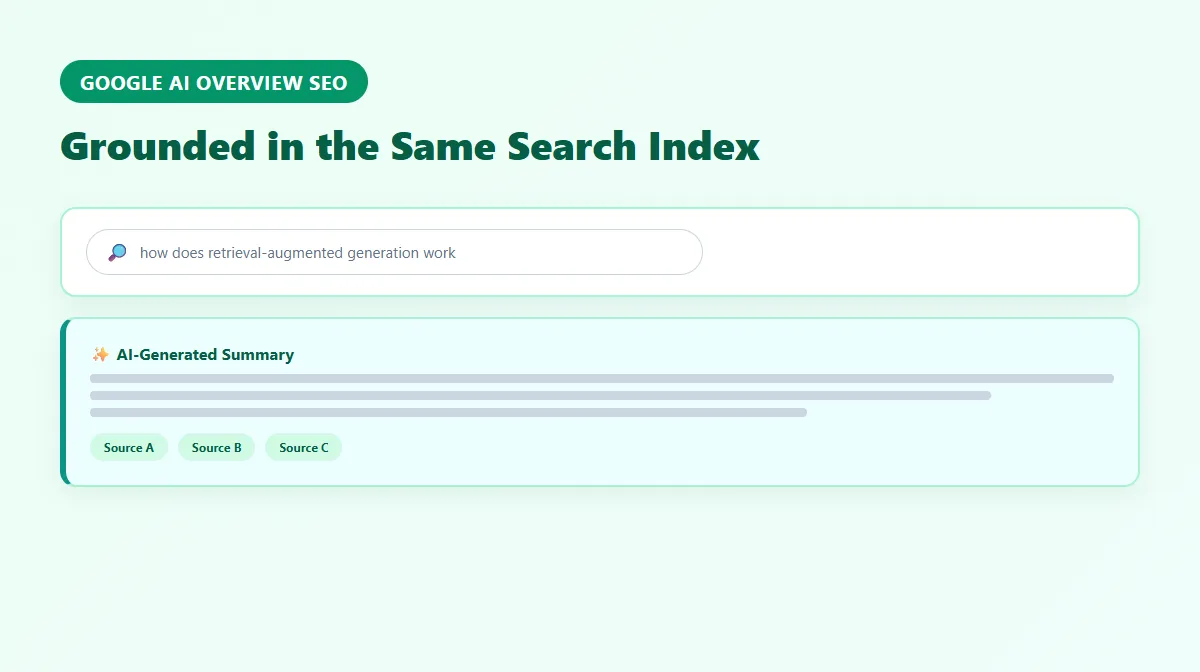
Google AI Overviews are an AI-generated summary feature that appears in Google Search results, synthesizing information from multiple sources in Google's index into a single answer — typically shown above the traditional list of organic results. They're one part of a broader shift Google calls its "generative AI features on Search," which also includes AI Mode.
What Are Google AI Overviews?
AI Overviews appear when Google's systems determine that a generative summary would be especially helpful — for example, when a query benefits from combining information across several sources rather than pointing to one page. Google has described the feature as relying on techniques like retrieval-augmented generation (RAG), also called "grounding": using retrieved content from its Search index to improve the accuracy and freshness of the generated response, powered by a version of its Gemini model customized for Search.
How AI Overviews Differ From Traditional Results
Traditional search results are a ranked list — ten links, each with a title, URL, and description, that a user scans and chooses among. AI Overviews instead generate a single written summary and typically cite a handful of sources inline, without presenting a numbered list of alternatives the way organic results do.
That structural difference is the reason "ranking" doesn't translate cleanly to AI Overviews. There's no position #1 through #10 to occupy — there's a question of whether your content was one of the sources used, and whether it was cited.
Can You Rank in Google AI Overviews?
Not in the traditional numbered sense. The more accurate way to frame it: can your content appear, be selected as a source, and be cited in the generated summary? Google's own guidance on this is notably direct — it states there are no additional requirements or special optimizations necessary to appear in AI Overviews or AI Mode. You don't need new machine-readable files, AI-specific text files, or special markup beyond the SEO practices that already apply to standard Search.
How Google Selects Sources
Google has stated that AI Overviews and AI Mode are rooted in its core Search ranking and quality systems — the same systems used to rank regular results — rather than a separate, independently documented algorithm. In practical terms, that means content generally needs to already be a strong candidate in regular organic search (crawlable, relevant, and considered trustworthy by Google's existing ranking systems) before it's likely to be drawn into a generated summary at all.
Google has also introduced a "Preferred Sources" feature within AI Mode and AI Overviews, which can highlight content from sites a user has specifically selected as a preferred source for a topic — a signal distinct from, and additional to, standard ranking.
How to Optimize for AI Overview Visibility
Because Google has stated the same core practices apply, the actionable guidance is largely standard SEO, with attention to a few things that matter more for a summarization feature specifically:
- Solid indexability and crawlability. Content that isn't reliably indexed can't be drawn into a summary that's grounded in the Search index.
- Helpful, direct content. Google's long-standing helpful-content guidance — answering the query clearly, without padding — applies directly here, since a vague or hedged answer is harder to summarize confidently.
- Clear factual statements. A summarization system benefits from content that states facts plainly rather than requiring inference across several paragraphs.
- Source quality and accuracy. Since generative summaries reflect Google's confidence in the underlying content, factual accuracy and credible sourcing remain foundational.
- Strong entity and site clarity. Being clearly and consistently identifiable as an authority on a topic helps across both traditional ranking and generative summarization.
Technical SEO and AI Overviews
There is no AI-Overview-specific technical requirement beyond what already applies to standard SEO: reliable crawling, correct indexing signals, clean canonicalization, and fast, accessible pages. If a page has technical issues that keep it out of Google's regular index, it's very unlikely to be considered for an AI Overview either, since the feature draws from that same index.
Content Strategy
Content that already performs well for direct-answer intent — clear definitions, comparison tables, step-by-step instructions, and specific, sourced facts — tends to be a stronger candidate for inclusion in a generative summary, for the same reason it tends to perform well for featured snippets: it's easier to extract a clean, confident answer from.
Citations / Source Visibility
When Google's AI features do cite a source, that citation functions differently from earning a normal organic ranking — it's a specific credit within the generated answer rather than a ranked link. There is currently no way to guarantee a citation; it follows from being a source Google's systems judged relevant, trustworthy, and useful enough to draw from and credit.
How to Measure AI Overview Performance
Google Search Console now includes reporting specifically for a site's performance within its generative AI features on Search — AI Overviews and AI Mode — alongside the existing organic Search reports. This is a genuine, first-party measurement option, and it's specific to Google; it doesn't tell you anything about how your content performs in ChatGPT, Perplexity, or other AI platforms. For visibility tracking that spans multiple AI platforms, see our guide on AI search visibility, which covers what's realistically measurable today across the broader AI-search landscape, and our Generative Engine Optimization guide for the underlying practices that carry across platforms.
Common Mistakes
- Assuming a separate "AI Overview algorithm" needs to be reverse-engineered. Google has stated the feature runs on its core Search systems — there is no known independent algorithm to game.
- Adding special markup expecting it to unlock AI Overview inclusion. Google explicitly says no special files or markup are required beyond standard SEO practices.
- Ignoring standard technical SEO. Since AI Overviews draw from the same Search index, technical issues that hurt organic visibility hurt AI Overview visibility too.
- Expecting a numbered ranking report. AI Overview "performance" is about appearance and citation, not position — measure it accordingly using Search Console's dedicated reporting.
Frequently Asked Questions
What are Google AI Overviews?
AI Overviews are an AI-generated summary feature in Google Search that answers a query by synthesizing information from multiple sources in Google's Search index, generally shown above the traditional list of results.
Can you rank in Google AI Overviews the way you rank in regular search results?
Not in the traditional numbered sense. AI Overviews don't display a ranked list of ten results — they generate a synthesized answer and typically cite a handful of sources. The more accurate framing is whether your content is selected as a source and cited, not what position it holds.
Does Google require special markup or an AI-specific file to appear in AI Overviews?
No. Google's own documentation states there are no additional requirements or special optimizations needed to appear in AI Overviews or AI Mode — you don't need new machine-readable files, AI-specific text files, or special markup beyond standard SEO practices.
Do standard SEO best practices still matter for AI Overviews?
Yes. Google has stated that AI Overviews and AI Mode are built on its core Search ranking and quality systems, and that the SEO best practices relevant to regular Search results remain relevant to these AI features as well.
How can I see how my site performs in Google's AI features?
Google Search Console has added reporting specifically for a site's performance within generative AI features on Search, including AI Overviews and AI Mode, alongside its existing organic Search reports.
Is there a separate 'AI Overview ranking algorithm'?
Google has not described a separate, independent ranking algorithm for AI Overviews. Its own guidance frames the feature as running on the same Search index and ranking systems used for regular results, with retrieval-augmented generation used to compose the summary from already-ranking content.
Try Our Free SEO Tools
Put what you learned into action with our free SEO analysis tools.