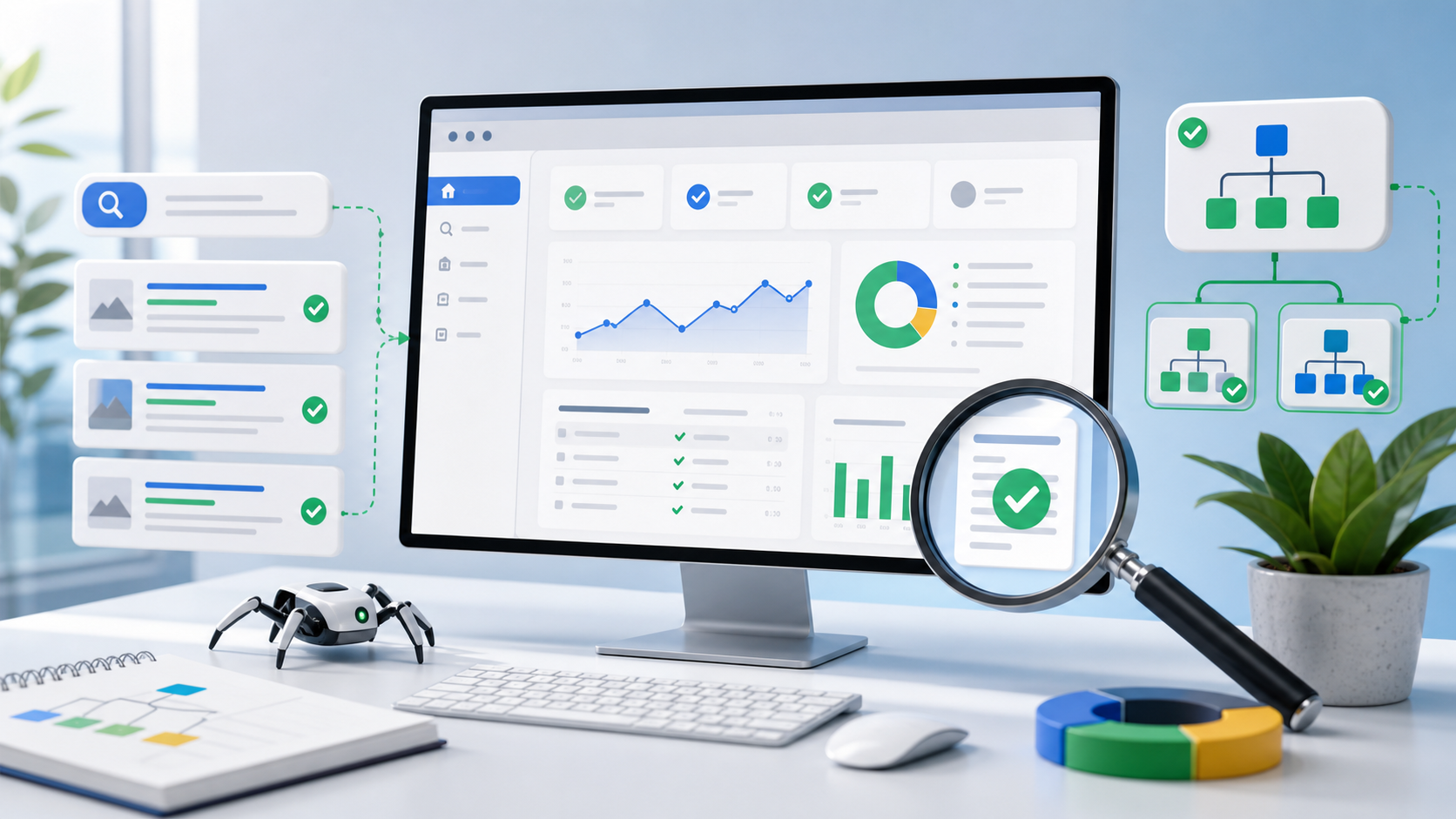
Complete Google Search Console Guide: Set Up, Inspect, Index, and Monitor SEO
Quick Links: Google Index Checker · Indexing Request Tool · XML & HTML Sitemap Generator · Robots.txt Generator · HTTP Status Checker · SEO Audit Tool · Meta Tag Generator
Google Search Console is your daily SEO control room
Google Search Console is a free Google tool that helps website owners understand how their site appears in Google Search. You can use it to submit your website, monitor search traffic, inspect URLs, submit sitemaps, check indexing issues, and find technical SEO problems before they quietly cost you traffic.
If Google cannot crawl, index, or understand your pages, even strong content can stay invisible. That is why Search Console should be part of every SEO workflow. It does not guarantee rankings, and it does not index every URL instantly, but it gives you the clearest direct view of how Google sees your website.
This guide walks through the full Google Search Console workflow: setup, verification, sitemap submission, URL Inspection, indexing requests, Page Indexing reports, Performance data, Core Web Vitals, links, security checks, and the daily habits that keep a site healthy.
If your main problem is that pages are not appearing in Google at all, also read our Google indexing guide and run a quick check with the Google Index Checker.
What is Google Search Console?
Google Search Console, often shortened to GSC, is an SEO monitoring platform for website owners, bloggers, agencies, developers, and marketers. It shows how Google crawls, indexes, and serves your pages in search results.
Search Console helps you answer important questions:
- Which queries bring impressions and clicks?
- Which pages are indexed?
- Which pages are excluded from the index?
- Is Google able to crawl a specific URL?
- Did your sitemap submit successfully?
- Are mobile, speed, or structured data issues affecting the site?
- Are important pages receiving enough internal links?
- Are there manual actions or security problems?
It is important to understand what Search Console is not. It is not a rank tracker, it is not a full analytics platform, and it is not a magic button for instant indexing. Think of it as a technical SEO command center that helps you diagnose and improve the site over time.
Step 1: Create or open Google Search Console
Start by going to Google Search Console and signing in with the Google account you want to use for managing the website.
After signing in, click Start Now. If your site is already connected, you will see the dashboard. If not, Google will ask you to add a property.
Use an account your business can keep long term. If a freelancer or employee sets up Search Console under a personal account and later leaves, ownership and access can become messy.
Step 2: Add your website property
Search Console gives you two main property options: Domain Property and URL Prefix Property.
Domain Property
A Domain Property tracks the full domain across protocols, subdomains, and URL versions. For example, it can cover:
example.comwww.example.comhttp://example.comhttps://example.comblog.example.com- Other subdomains on the same domain
This is the best option for most businesses because it gives the broadest view of the website.
URL Prefix Property
A URL Prefix Property tracks only the exact version you enter, such as:
https://www.example.com
Use this when you want to monitor one specific version of the site or when DNS verification is not available. Just remember that http, https, www, and non-www versions can be treated separately in this setup.
Step 3: Verify website ownership
Google must confirm that you own or manage the website before it shows private search data. The available verification methods depend on the property type.
| Verification method | Best for | What you do |
|---|---|---|
| DNS TXT record | Domain Property | Add Google's TXT record in your domain DNS settings, then click Verify. |
| HTML file upload | URL Prefix Property | Upload Google's HTML verification file to the website root folder. |
| HTML tag | URL Prefix Property | Add Google's meta tag inside the homepage <head> section. |
| Google Analytics | Sites already using GA | Verify with the same Google account used for Analytics. |
| Google Tag Manager | Sites using GTM | Verify ownership through the GTM container. |
DNS verification is usually the strongest choice for full-domain tracking. If your DNS changes take time to propagate, wait a little and verify again.
Step 4: Submit your sitemap
A sitemap helps Google discover important URLs on your website. Most websites use an XML sitemap at a URL like:
https://example.com/sitemap.xml
In Search Console, open Sitemaps, enter your sitemap path, and click Submit. After submission, check whether the status shows success and whether Google discovered the expected number of URLs.
If you do not have a sitemap yet, create one with the XML & HTML Sitemap Generator. A clean sitemap should include canonical, indexable URLs and avoid broken pages, redirects, duplicate URLs, and old staging paths.
For a deeper sitemap and indexing workflow, read our indexing services guide.
Step 5: Use the Overview page
The Overview page gives a quick health snapshot of your website. It highlights important changes, notifications, indexing status, performance trends, recommendations, and enhancement reports.
Check this page daily if the site is important to your business. You do not need to spend an hour there every morning, but you should know if Google suddenly finds new indexing errors, mobile issues, sitemap problems, or security warnings.
Step 6: Use the Performance report
The Performance report shows how your website performs in Google Search. It is one of the most useful areas in Search Console because it connects real search visibility with real user clicks.
You can review:
- Total clicks
- Total impressions
- Average CTR
- Average position
- Search queries
- Pages receiving traffic
- Countries
- Devices
- Search appearance
- Date ranges
Use this report to find keywords that already generate impressions but not enough clicks. Those pages often need better title tags, stronger meta descriptions, improved headings, richer content, or a clearer search intent match.
If a page has high impressions and low CTR, improve the snippet with the Meta Tag Generator and read our Meta Tags SEO Guide.
Step 7: Use the URL Inspection tool
The URL Inspection tool shows what Google knows about a specific page. It can reveal indexing status, crawling information, selected canonicals, structured data, video signals, AMP details, and whether the page can be indexed.
To inspect a URL:
- Copy the full page URL.
- Paste it into the top Search Console inspection bar.
- Press Enter.
- Wait for Google to check the URL.
- Review the result carefully.
Common URL Inspection results include:
- URL is on Google: The page is indexed and eligible to appear in search results.
- URL is not on Google: The page is not indexed or is blocked from appearing.
- Crawled - currently not indexed: Google crawled the page but did not index it.
- Discovered - currently not indexed: Google found the URL but has not crawled it yet.
- Duplicate without user-selected canonical: Google found a duplicate and selected another canonical.
- Page with redirect: The inspected URL redirects elsewhere.
- Blocked by robots.txt: Crawling is blocked by robots rules.
- Excluded by noindex tag: The page tells Google not to index it.
For quick external checks, use the Google Index Checker, then use Search Console for the detailed diagnosis.
Step 8: Test the live URL
After inspecting a URL, click Test Live URL. This checks the current live version of the page, not just the last version Google crawled.
Use the live test when:
- You published a new page.
- You updated the content.
- You fixed an indexing issue.
- You removed a
noindextag. - You fixed robots.txt blocking.
- You changed canonical tags.
- You corrected structured data.
- You repaired a page that was returning the wrong status code.
Before requesting indexing, confirm that the live test is successful and the page is truly indexable.
Step 9: Request indexing
If the live test looks good, click Request Indexing. This sends the URL to Google for crawling or rechecking.
Requesting indexing does not guarantee instant indexing or ranking. It simply asks Google to consider the URL again. Google still decides when to crawl, whether to index, and whether the content deserves to appear in search.
Good candidates for indexing requests include:
- New blog posts
- Updated service pages
- Product pages
- Location pages
- Pages where you fixed errors
- Important URLs that are not indexed yet
- Pages with improved content and internal links
Do not waste indexing requests on thin, duplicate, blocked, redirected, or low-quality pages. Fix the page first, then request indexing.
If you manage many URLs, the Indexing Request Tool can help you organize indexing work outside the manual Search Console routine.
Important note about Search Console data delays
One common beginner mistake is expecting Search Console to show everything immediately after publishing a page or requesting indexing.
Search Console data is not always real time. Performance data, impressions, clicks, indexing updates, and enhancement reports can take several days to appear. For newer websites or weaker domains, meaningful indexing and performance changes may take one to two weeks or longer.
Indexing speed depends on many signals:
- Website authority
- Content quality
- Internal linking
- Crawl budget
- Backlink profile
- Website freshness
- Technical SEO health
- Server reliability
Avoid requesting indexing for the same URL every day. Instead, improve the page, add relevant internal links, include it in the sitemap, and make sure Google can crawl it cleanly.
How backlinks help pages get discovered faster
Search Console gives you URL Inspection and indexing request features, but links still matter for discovery. When trusted websites link to your content, Google can find and revisit your pages more easily.
Backlinks can help new blog posts, service pages, landing pages, and campaign URLs get discovered faster than relying only on manual submissions. Internal links matter too. A page linked from your homepage, category pages, related guides, and tool pages is easier for Google to find than an orphan URL sitting alone.
For example, if you publish a new Search Console guide, link to it from your SEO Audit Tool guide, your Google Index Checker guide, and relevant SEO tools.
Speed up indexing with an organized workflow
If you regularly publish content, build backlinks, or manage multiple websites, manually inspecting and requesting indexing for every URL can become time-consuming.
An organized indexing workflow helps you:
- Submit URLs more efficiently
- Manage bulk URL indexing campaigns
- Track indexing progress
- Monitor indexed and non-indexed URLs
- Improve content discovery
- Save time compared to manual checks
This is especially useful for:
- SEO agencies
- Affiliate websites
- Local SEO campaigns
- E-commerce stores
- News websites
- Businesses publishing content regularly
No indexing tool can guarantee that Google will index every page. Search Console should remain your primary website monitoring platform, while tools like our Indexing Request Tool help you organize and accelerate the workflow.
Ready to get more pages discovered?
If you want a faster indexing workflow, start with your highest-value URLs, fix technical blockers, improve internal links, and use a consistent request-and-monitor process.
Step 10: Check the Page Indexing report
The Page Indexing report shows which pages Google knows about, which pages are indexed, and which pages have indexing problems.
Common statuses include:
Indexed
The page is indexed and can appear in Google Search.
Not indexed
The page is known to Google but is not indexed. The exact reason matters, so open the issue details before deciding what to fix.
Crawled - currently not indexed
Google crawled the page but has not indexed it. Improve content quality, internal links, uniqueness, and page value. Also check that Google is not selecting a different canonical URL.
Discovered - currently not indexed
Google found the URL but has not crawled it yet. This can happen because of crawl budget, weak internal linking, site quality signals, or the URL being low priority.
Duplicate page
Google found duplicate or very similar content. Fix canonical tags, redirects, internal links, and content uniqueness so the preferred page is clear.
Blocked by robots.txt
Your robots.txt file is stopping Google from crawling the page. Use the Robots.txt Generator to build cleaner rules and make sure important paths are not blocked.
Excluded by the noindex tag
The page has a noindex directive, so Google will not index it. Remove the tag only if the page should appear in search results.
Step 11: Fix indexing issues before resubmitting
Before requesting indexing again, check the basics.
Make sure:
- The page returns a clean
200status code. - The page is not blocked by robots.txt.
- The page does not have a
noindextag. - The canonical tag points to the correct URL.
- The content is original and useful.
- The page has relevant internal links.
- The page loads properly on mobile.
- The sitemap includes the correct URL.
- The URL is not stuck in a bad redirect chain.
- The page is not thin, duplicated, or auto-generated.
Use the HTTP Status Checker to catch status code problems, and read our guide on how to check HTTP status codes for SEO if you need a deeper walkthrough.
Step 12: Use the Sitemaps report
The Sitemaps section helps you submit and monitor XML sitemaps. It is also useful for spotting sitemap quality problems.
Check:
- Sitemap submitted successfully
- Number of discovered URLs
- Errors in the sitemap
- Old sitemap URLs
- Wrong HTTP or HTTPS versions
- Broken URLs inside the sitemap
- Redirected URLs that should be replaced with final URLs
Keep your sitemap clean and up to date. A messy sitemap wastes crawl signals and makes it harder to understand what you actually want Google to index.
Step 13: Use the Removals tool carefully
The Removals tool is used to temporarily remove a URL from Google Search results. It is helpful when something should disappear quickly, but it is not a replacement for fixing the page itself.
Use it for:
- Deleted pages
- Private pages accidentally indexed
- Sensitive content
- Old URLs you do not want shown
For permanent removal, also delete the page, add a proper noindex tag, require authentication, or fix the underlying access problem.
Step 14: Use Core Web Vitals
Core Web Vitals show user experience and speed issues. In Search Console, they help you spot groups of URLs with poor experience signals.
Key metrics include:
- LCP: Loading performance.
- INP: Interaction responsiveness.
- CLS: Visual stability.
Fixing these issues can improve user experience and may support stronger SEO performance over time. If speed, redirects, broken links, and technical errors are all messy, run a broader check with the SEO Audit Tool.
Step 15: Review experience and mobile issues
Search Console can show mobile usability and page experience issues that make pages harder to use.
Fix problems like:
- Text too small to read
- Clickable elements too close together
- Content wider than the screen
- Slow loading pages
- Poor mobile layout
- Intrusive elements that block the main content
Google Search is mobile-first, so do not treat mobile issues as cosmetic. A page that is hard to use on mobile is harder to trust, convert, and grow.
Step 16: Use Enhancements reports
Enhancement reports appear when Google detects supported structured data or special search features on your site.
These may include:
- Breadcrumbs
- Products
- Reviews
- FAQs
- Videos
- Events
- Recipes
- Merchant listings
Use these reports to fix structured data errors and improve rich result eligibility. If you use schema markup, validate it after major template changes.
Step 17: Use the Links report
The Links report shows internal and external link signals.
Review:
- Which websites link to you
- Which pages get the most backlinks
- Which pages have the most internal links
- Anchor text used by other websites
- Important pages with weak internal linking
Strong internal linking helps Google discover and understand your pages. If an important page has almost no internal links, add contextual links from related posts, tool pages, category pages, and navigation where appropriate.
Step 18: Check Security and Manual Actions
Check these reports regularly, especially if traffic drops suddenly.
Manual Actions
This report shows whether Google has applied a manual penalty to your website. Manual actions can seriously affect search visibility and should be handled quickly.
Security Issues
This report can show hacked content, malware, harmful downloads, or suspicious website behavior. Fix security problems immediately because they can harm users, rankings, and brand trust.
Daily Google Search Console routine
Here is a practical daily workflow for active websites:
- Open Search Console.
- Check Overview for alerts.
- Review Performance for clicks, impressions, CTR, and ranking movement.
- Check Page Indexing for new errors.
- Inspect 10 to 15 important URLs.
- Run Live Test for changed or important URLs.
- Request indexing only when the page is valid.
- Check sitemap status.
- Review Core Web Vitals or mobile issues.
- Note pages that need content or technical SEO fixes.
This does not need to take all day. The goal is to build a steady monitoring habit so problems are caught while they are still small.
Weekly Google Search Console routine
Once a week, go deeper.
| Weekly task | Why it matters |
|---|---|
| Export top queries | Find keywords already getting impressions. |
| Find low-CTR pages | Improve titles and descriptions. |
| Check pages losing clicks | Catch ranking drops early. |
| Review indexing errors | Fix crawl and indexability blockers. |
| Review sitemap coverage | Make sure important URLs are discoverable. |
| Check new backlinks | Understand discovery and authority signals. |
| Review Core Web Vitals | Spot template-level speed issues. |
| Update old content | Keep important pages fresh and useful. |
| Add internal links | Help Google and users find priority pages. |
Pair this routine with a monthly technical audit. Our SEO audit guide explains what to check beyond Search Console.
Best practices for URL Inspection and indexing
Do not request indexing blindly. First, make sure the page is ready.
Before clicking Request Indexing, confirm:
- Content is complete.
- Page is crawlable.
- Page is indexable.
- Canonical is correct.
- Page has internal links.
- Sitemap includes the page.
- Page loads fast.
- Page works on mobile.
- The page solves a real search intent.
Indexing requests work best when they support a clean site structure and strong content. They work poorly when used to push weak pages that Google has good reasons to ignore.
Common Google Search Console mistakes
Avoid these common mistakes:
- Adding only
httpwhen the live site useshttps. - Not verifying all important domain versions.
- Forgetting to submit the sitemap.
- Requesting indexing for low-quality pages.
- Ignoring canonical errors.
- Blocking important pages in robots.txt.
- Leaving
noindextags on live pages. - Not checking mobile usability.
- Not reviewing Performance data.
- Thinking indexing request guarantees ranking.
- Expecting Search Console data to update instantly.
- Treating Search Console as a replacement for analytics.
Most Search Console wins come from consistency. Check the reports, fix what matters, and keep improving the pages that already show promise.
Important Google Search Console features
The most useful Search Console features are:
- Performance report
- URL Inspection tool
- Request Indexing
- Page Indexing report
- Sitemaps
- Core Web Vitals
- Enhancements
- Links report
- Removals tool
- Security issues
- Manual actions
- Settings and ownership verification
You do not need to master every report on day one. Start with setup, sitemap submission, URL Inspection, Performance, and Page Indexing. Those areas cover most everyday SEO monitoring needs.
Conclusion
Google Search Console is essential for every website owner, SEO expert, blogger, and business. It helps you understand how Google sees your website, which pages are indexed, which keywords bring traffic, and which technical issues need fixing.
For best results, use Search Console consistently. Inspect important URLs, request indexing only after checking the live URL, monitor indexing errors, submit a clean sitemap, and keep improving your website content and technical SEO.
When used properly, Google Search Console becomes a complete website health, indexing, and SEO monitoring tool.
Final thoughts
Indexing is a process, not an instant action. Focus on publishing helpful content, building relevant internal links, earning quality backlinks, maintaining a clean site structure, and using Google Search Console as your daily source of truth.
If you want to take action now, start with one high-value URL: inspect it in Search Console, test the live page, check whether it is indexed with the Google Index Checker, verify the HTTP status with the HTTP Status Checker, and then request indexing only if everything is clean.
Try Our Free SEO Tools
Put what you learned into action with our free SEO analysis tools.