How to Convert Octal to Decimal: Formula, Steps & Examples
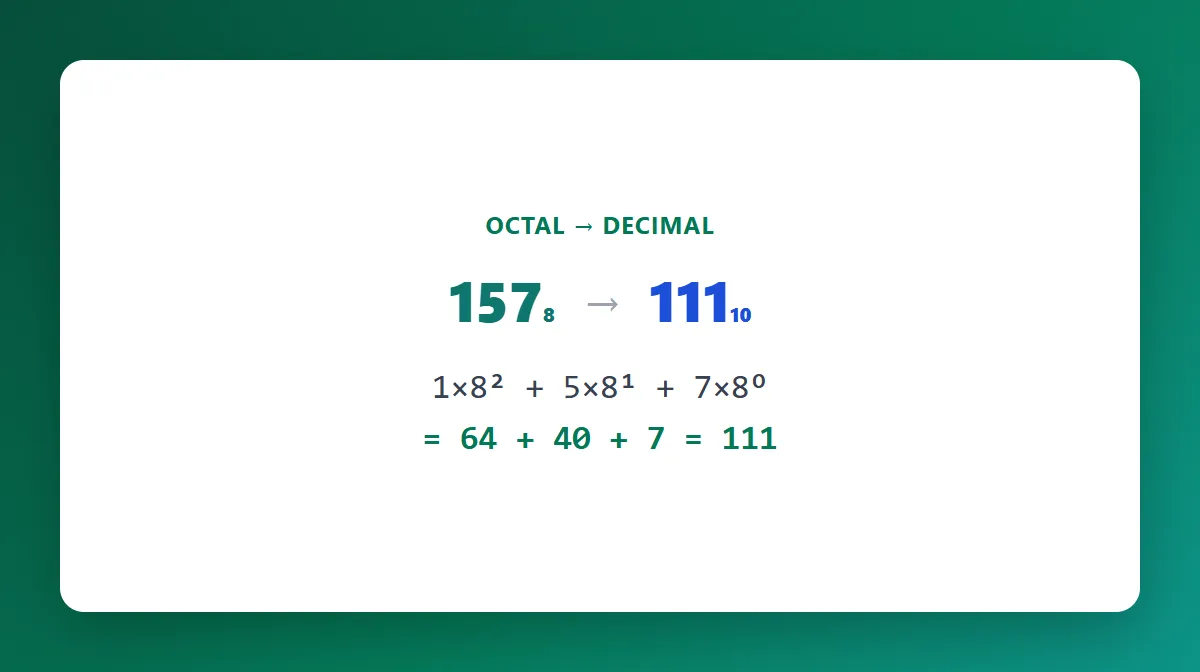
To convert octal to decimal, multiply each octal digit by 8 raised to the power of its position, starting with 8⁰ at the rightmost digit, then add the results together. For example, octal 157 converts to decimal 111: (1 × 64) + (5 × 8) + (7 × 1) = 64 + 40 + 7 = 111. This guide walks through the formula behind that math, a repeatable step-by-step process, and several verified examples of increasing difficulty.
What Is the Octal Number System?
Octal is a base-8 number system. It uses only eight digit symbols — 0 through 7 — so unlike hexadecimal, it never needs letters; every octal digit already matches a familiar decimal value.
Like decimal, octal is a positional number system: each digit's value depends on where it sits, not just which symbol it is. Moving one position to the left multiplies the place value by 8 instead of by 10:
| Position | Place Value |
|---|---|
| 8⁰ | 1 |
| 8¹ | 8 |
| 8² | 64 |
| 8³ | 512 |
| 8⁴ | 4,096 |
So the octal number 21 doesn't mean twenty-one — it means (2 × 8) + (1 × 1) = 17 in decimal, because the "2" sits in the 8s place rather than the 10s place.
What Is the Decimal Number System?
Decimal is the base-10 system used for everyday counting, built from the ten digits 0 through 9. Each position represents a power of 10 (1, 10, 100, 1,000...). Converting octal to decimal means re-expressing the same quantity using base 10's rules instead of base 8's — the number itself doesn't change, only the notation used to write it.
Octal to Decimal Formula
For an octal number with digits dₙ through d₀ (read left to right), the decimal value is:
dₙ × 8ⁿ + ... + d₂ × 8² + d₁ × 8¹ + d₀ × 8⁰
In plain terms: the rightmost digit is worth its face value (8⁰ = 1), the next digit left is worth 8 times its face value (8¹ = 8), the one after that is worth 64 times its face value (8² = 64), and so on. Multiply each digit by its place value and add everything up. Because every octal digit is already 0-7, there's no digit substitution step — unlike hex, where letters A-F first have to be converted to 10-15.
How to Convert Octal to Decimal Step by Step
- Write the octal number, left to right.
- Assign powers of 8 from right to left, starting at 8⁰ for the rightmost digit.
- Multiply each digit by its place value.
- Add the results together to get the decimal number.
This process works for an octal number of any length — only the number of place values changes.
Octal to Decimal Example: 157 (base 8)
Digit:      1     5     7
Position:   2     1     0
Value:     64     8     1

1 × 64 = 64
5 × 8  = 40
7 × 1  = 7

64 + 40 + 7 = 111

157₈ = 111₁₀
More Octal to Decimal Examples
Here are several more worked examples, each checked digit by digit.
Example: Octal 10
1 × 8 = 8
0 × 1 = 0

8 + 0 = 8

10₈ = 8₁₀
Example: Octal 52
5 × 8 = 40
2 × 1 = 2

40 + 2 = 42

52₈ = 42₁₀
Example: Octal 345
3 × 64 = 192
4 × 8  = 32
5 × 1  = 5

192 + 32 + 5 = 229

345₈ = 229₁₀
Example: Octal 725
7 × 64 = 448
2 × 8  = 16
5 × 1  = 5

448 + 16 + 5 = 469

725₈ = 469₁₀
Example: Octal 1234
1 × 512 = 512
2 × 64  = 128
3 × 8   = 24
4 × 1   = 4

512 + 128 + 24 + 4 = 668

1234₈ = 668₁₀
| Octal | Expanded Form | Decimal |
|---|---|---|
| 10 | 1×8 + 0×1 | 8 |
| 17 | 1×8 + 7×1 | 15 |
| 52 | 5×8 + 2×1 | 42 |
| 100 | 1×64 + 0×8 + 0×1 | 64 |
| 157 | 1×64 + 5×8 + 7×1 | 111 |
| 345 | 3×64 + 4×8 + 5×1 | 229 |
| 725 | 7×64 + 2×8 + 5×1 | 469 |
| 1234 | 1×512 + 2×64 + 3×8 + 4×1 | 668 |
If you want to check your own calculation, use the Octal to Decimal Converter — it shows the same digit-by-digit breakdown for any octal value you enter.
Octal to Decimal Place Value Table
A quick reference for the place values used in the conversion:
| Power | Decimal Value |
|---|---|
| 8⁰ | 1 |
| 8¹ | 8 |
| 8² | 64 |
| 8³ | 512 |
| 8⁴ | 4,096 |
| 8⁵ | 32,768 |
How to Check an Octal to Decimal Conversion
Two reliable ways to verify a conversion:
- Recalculate the positional expansion. Rewrite each digit-times-place-value term and re-add them — a wrong final answer is almost always a slipped multiplication or a mis-added column, not a flawed method.
- Use the converter. The Octal to Decimal Converter accepts an octal integer of any length and shows the same digit-by-digit breakdown used in this article, so you can compare it line by line against your own working.
Why Octal and Binary Are Closely Related
Each octal digit corresponds to exactly 3 binary bits, because 8 is 2³ — three bits can represent exactly eight values (000 through 111), which lines up perfectly with octal's eight digit symbols (0-7):
| Octal Digit | Binary (3 bits) |
|---|---|
| 0 | 000 |
| 1 | 001 |
| 2 | 010 |
| 3 | 011 |
| 4 | 100 |
| 5 | 101 |
| 6 | 110 |
| 7 | 111 |
That clean mapping makes octal a compact way to write binary data without converting all the way to decimal — grouping a binary string into sets of three bits from the right and converting each group independently gives the octal equivalent directly. See Why Do Computers Use Binary? for more on how binary underlies the other systems, or How to Convert Octal to Binary for the full step-by-step method. For the reverse direction, the Octal to Binary Converter shows that grouping step by step. The same binary bridge also connects octal directly to hexadecimal — see How to Convert Octal to Hexadecimal if you need that conversion instead.
Common Octal to Decimal Conversion Mistakes
- Using powers of 10 instead of powers of 8. This is the most common slip — octal place values are 1, 8, 64, 512, not 1, 10, 100, 1000.
- Numbering positions from the wrong side. The rightmost digit is always position 0; counting from the left instead flips every place value.
- Forgetting that the rightmost position is 8⁰. 8⁰ equals 1, not 0 — a digit in the rightmost place is worth its face value.
- Accepting the digits 8 or 9. Octal only has eight valid digit symbols, 0 through 7. A number like 189 or 98 was never valid octal to begin with.
- Multiplying correctly but adding incorrectly. With three or more digits, it's easy to drop a term or mistype a partial sum — add the column of products last, and double-check it separately from the multiplication.
- Confusing decimal-to-octal with octal-to-decimal. The two conversions use different manual procedures (see the next section) — applying the wrong one gives a result that looks plausible but isn't the value you wanted.
Octal to Decimal vs Decimal to Octal
Octal-to-decimal and decimal-to-octal are inverse operations, but they don't share a manual procedure:
- Octal to decimal multiplies each digit by its power-of-8 place value and adds the products, as shown throughout this guide.
- Decimal to octal works the opposite way: repeatedly divide the decimal number by 8, record each remainder, and read the remainders from bottom to top. For example, converting decimal 42 to octal: 42 ÷ 8 = 5 remainder 2, then 5 ÷ 8 = 0 remainder 5 — reading the remainders bottom-to-top gives octal 52, which matches the 52 (base 8) = 42 (base 10) example above.
See How to Convert Decimal to Octal for the full step-by-step method and worked examples, or use the Base Converter, which handles the decimal-to-octal direction (and any other base pairing) automatically if you need the reverse conversion without doing the division by hand.
When Is Octal Used?
Octal shows up in a few specific, still-active contexts rather than everyday computing:
- Unix/Linux file permissions.
chmodcommands use three-digit octal values, such as 755 or 644, where each digit encodes read (4), write (2), and execute (1) permissions for the owner, group, and others. Converting 755 to decimal gives (7 × 64) + (5 × 8) + (5 × 1) = 448 + 40 + 5 = 493. - Legacy computer architectures. Some early minicomputers used word sizes divisible by 3 bits (such as 12, 24, or 36 bits), which made octal a natural, compact way to display raw binary values — a role that hexadecimal has largely taken over on modern 8-, 16-, 32-, and 64-bit systems.
- Computer science education. Because the digit-by-digit method is identical to decimal and hexadecimal conversion, just with a different base, octal-to-decimal conversion is a standard exercise for teaching positional number systems.
Frequently Asked Questions
How do you convert octal to decimal? Multiply each octal digit by 8 raised to its position, counting positions from 0 at the rightmost digit, then add the results. For example, 157 (base 8) = (1 × 8²) + (5 × 8¹) + (7 × 8⁰) = 64 + 40 + 7 = 111 in decimal.
What is the formula for octal to decimal conversion? For an octal number with digits dₙ...d₁d₀, the decimal value is dₙ×8ⁿ + ... + d₁×8¹ + d₀×8⁰. Each digit is multiplied by the power of 8 matching its position, and those products are summed to get the decimal result.
What is 157 octal in decimal? 157 (base 8) equals 111 in decimal: (1 × 64) + (5 × 8) + (7 × 1) = 64 + 40 + 7 = 111.
Why does octal use powers of 8? Octal is a base-8 number system, so each digit position represents how many of that power of 8 are present, the same way each decimal position represents a power of 10. Base 8 was chosen because it divides evenly into groups of 3 binary bits (2³ = 8).
Can an octal number contain 8 or 9? No. Octal only uses the digits 0 through 7. A number containing an 8 or a 9, such as 189, is not a valid octal value.
Is octal base 8 or base 10? Octal is base 8. Decimal, the number system most people count in every day, is base 10. "Octal to decimal" means converting a base-8 value into its base-10 equivalent.
How are octal and binary related? Each octal digit corresponds to exactly 3 binary bits, because 8 is 2³. This makes octal a compact way to write binary values without doing a full binary-to-decimal conversion.
How can I check an octal-to-decimal conversion? Recompute the positional expansion by hand, or enter the value into the Octal to Decimal Converter, which shows the same digit-by-digit breakdown for any octal input.
Try Our Free SEO Tools
Put what you learned into action with our free SEO analysis tools.