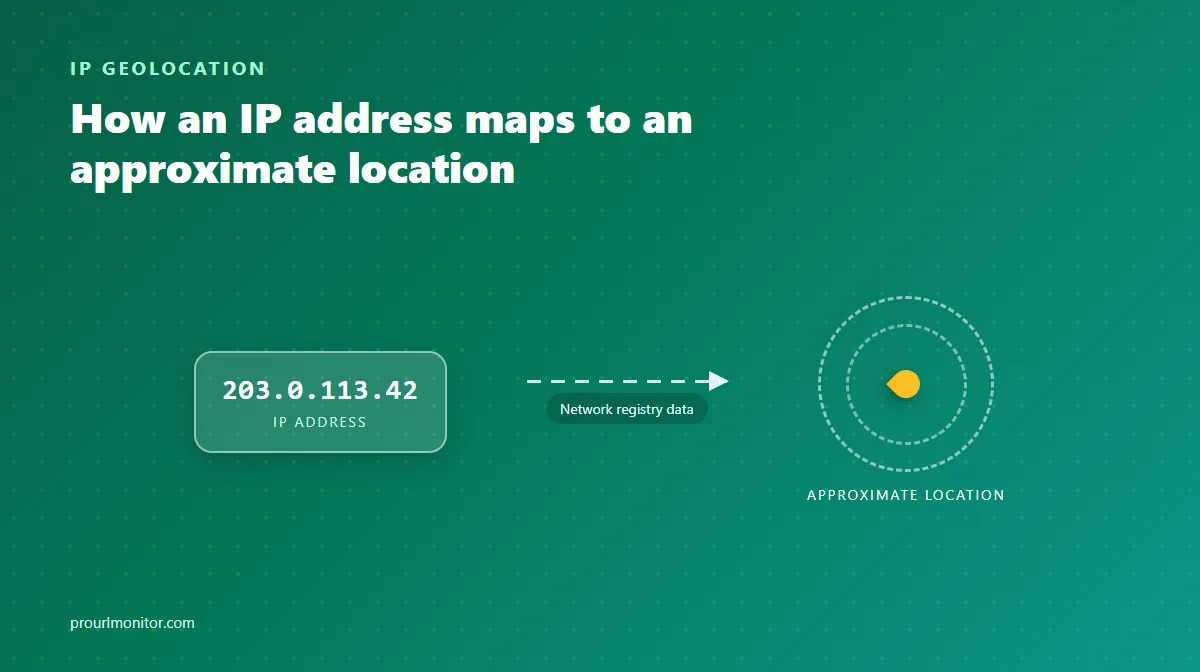
What Is IP Geolocation and How Does It Work?
Every device on the internet is reachable at an IP address, and it's long been possible to turn that address into a rough idea of where it's used — a country, sometimes a city, sometimes very little at all. That process is IP geolocation, and it's easy to overestimate what it actually does. It doesn't track a device. It doesn't use GPS. It looks up which network the address belongs to and reports where that network is registered or routed.
This guide explains what's actually happening behind an IP geolocation lookup, what data it draws on, and where the estimate breaks down — including IPv4 vs. IPv6, VPNs, mobile networks, and CDNs. If you want to run a real lookup rather than read about the mechanics, ProURLMonitor's IP Location Finder does the same thing this article describes, returning country, region, city, coordinates, timezone, and network/ASN data for any public IP or domain.
IP Geolocation, Defined
IP geolocation is the practice of estimating a physical location associated with an IP address by matching it against records of how that address is allocated and routed — not by observing the device itself. The result is always an approximation built from someone else's data about the network, not a live signal from the IP's current user.
That distinction matters because it sets expectations correctly from the start: a geolocation lookup answers "which network does this address belong to, and where is that network generally located?" — not "where is this specific device right now?"
How IP Addresses Relate to Networks
No IP address is handed out in isolation. Addresses are allocated in blocks — ranges like 93.184.216.0/24 — to internet service providers, hosting companies, and large organizations by one of five Regional Internet Registries (RIRs): ARIN, RIPE NCC, APNIC, LACNIC, and AFRINIC, each covering a different part of the world. Whoever holds a block then assigns individual addresses within it to their own customers or infrastructure.
This registration hierarchy is the real foundation of IP geolocation. A registry record for a block typically shows which organization holds it and which country or region it was allocated to — information that's public, structured, and queryable through RDAP (the Registration Data Access Protocol) or the older WHOIS system. That's also where an IP's ASN (Autonomous System Number) and registered network organization come from: the ASN identifies the network that operates and routes the address, independent of any geolocation guess about where its users physically are.
Where Geolocation Databases Get Their Data
Registry allocation records establish who operates an address block and roughly where it was assigned, but they're often too coarse for city-level estimates on their own. Geolocation providers combine that registry baseline with additional signals: data submitted by ISPs about their own network layout, patterns observed in routing and network latency, and — for some providers — voluntary or licensed location data tied to specific ranges.
The result is a lookup table: a database mapping address ranges to a best-guess location, refreshed on whatever schedule that provider uses. Some ranges are well-documented and stable (a large ISP's residential block in one city, for example); others are vague, recently reassigned, or simply under-covered, which is a large part of why accuracy varies so much between IPs.
What the Estimate Actually Covers
A typical lookup can return several distinct fields, and they're not equally trustworthy:
| Field | What it reflects | Reliability |
|---|---|---|
| Country | Registry allocation + routing — usually well established | Generally reliable |
| Region / City | Provider's database estimate for the specific address range | Approximate, varies by provider |
| Latitude / longitude | A representative point for the matched location — often a city or network centroid | Approximate; not a precise device position |
| ASN / Organization | Registry data identifying the network operator | Reliable — this is registration fact, not a geolocation guess |
| Timezone | Derived from the matched country/region | Reliable only when the country has a single time zone |
Country-level results hold up well because they're anchored to registry allocation, which rarely changes and is publicly documented. City and coordinate-level results are inherently softer — they depend on a specific provider's database coverage for that exact address range at that exact moment.
IPv4 and IPv6
The mechanics are the same for both address families: allocation through the RIR system, ASN-based routing, and geolocation databases built the same way. In practice, IPv6 coverage can lag IPv4 in some providers' databases simply because IPv6 deployment and reassignment have accelerated more recently than IPv4's decades-long history — a gap that's closing but not always fully closed.
Why Different Databases Disagree
Ask two geolocation providers about the same IP and you may get two different cities, especially for ranges that have recently changed hands, belong to a large ISP with regionally dispersed customers, or simply aren't well covered by one provider's data sources. This isn't a sign that geolocation is "broken" — it's a direct consequence of every provider building its own independent database from its own mix of registry data, ISP submissions, and routing signals, refreshed on its own schedule. Country-level answers converge far more often than city-level ones, precisely because the country field rests on the more stable registry layer.
VPNs, Proxies, Mobile Networks, and CDNs
IP geolocation reports the location of the network the address belongs to — not the location of whoever is using it. Four situations commonly break the intuitive link between "IP location" and "actual location":
- VPNs and proxies route traffic through their own servers, so the IP a geolocation lookup sees is the VPN/proxy server's network, not the original user's.
- Mobile networks often route many users through a small number of gateway addresses that can be geolocated to a regional hub rather than each user's specific location.
- CGNAT (carrier-grade NAT), common on mobile and some broadband networks, means many customers share the same public IP, which is registered to one location regardless of where those individual customers actually are.
- CDNs and load-balanced domains frequently resolve a single domain name to multiple IP addresses in different data centers, so "the" location of a domain can genuinely mean several different locations depending on which address you resolve to and when.
Common Privacy Misconceptions
Because "IP location" sounds precise, it's easy to overstate what it can do. Two claims worth correcting directly: an IP address alone cannot be turned into a street address by a geolocation lookup — that data isn't in any public database, and only the assigning ISP can link an address to a specific subscriber, typically only through a legal process. And an IP address is not a stable proxy for identity — dynamic IP assignment, shared CGNAT addresses, and VPN use all mean the same person can appear at different IPs, and the same IP can correspond to different people over time.
Practical Uses
None of this means IP geolocation is useless — it's the basis for several legitimate, widely used practices: coarse content localization (serving a default language or currency), basic analytics on where traffic originates at a country level, simple compliance-driven access restrictions, and CDN routing decisions based on network proximity. All of these work precisely because they only need country- or region-level confidence, not device-level precision.
Frequently Asked Questions
What is IP geolocation?
IP geolocation is the process of estimating the approximate physical location — typically country, region, or city — associated with an IP address, using network-registration and routing data rather than GPS or device sensors. It identifies where an IP address is registered or routed, not the exact location of the device using it at any given moment.
How does IP geolocation work?
Geolocation providers build databases that map IP address ranges to locations, using sources like regional internet registry (RIR) allocation records, ISP-submitted data, routing information, and other network signals. When you look up an IP, the provider matches it against the range it falls into and returns that range's associated location — an estimate, not a live signal from the device itself.
What information can IP geolocation reveal?
A geolocation lookup can typically return country (usually reliable), region and city (approximate estimates), latitude/longitude (often a network or city centroid, not an exact point), and network details like the ASN and registered organization that operates the address range. It does not reveal a street address, a person's identity, or a device's real-time GPS position.
Does IP geolocation use GPS?
No. IP geolocation is derived entirely from network data — which organization registered an address range, how it's routed, and which databases have recorded a location for it. GPS geolocation, by contrast, comes from a device's own satellite receiver and is a completely different (and far more precise) technology. Browsers and apps that ask for "your location" are usually using GPS or Wi-Fi positioning, not an IP lookup.
Can an IP address be traced to a home address?
Not through IP geolocation. Public geolocation databases stop at approximate city or region level. Only the ISP that assigned the address knows which subscriber was using it at a given time, and that information is only released to law enforcement or other parties through a legal process — it isn't something a geolocation lookup can produce.
Do all IP geolocation databases give the same answer?
No. Different providers combine different data sources, update on different schedules, and use different estimation logic, so it's common for two geolocation lookups on the same IP to return slightly different cities or coordinates, especially outside the country level. Country-level results agree far more often than city-level ones.
Does IP geolocation work for both IPv4 and IPv6?
Yes. Both address families are allocated and routed through the same regional registry system, so geolocation providers maintain databases for IPv4 and IPv6 alike. Coverage and accuracy for IPv6 can lag IPv4 in some databases simply because IPv6 adoption and reallocation are more recent.
Try a Real Lookup
Everything above describes what's happening behind the scenes of any IP geolocation tool. To see it applied to a real address or domain — including the ASN, registered network organization, and a check against the Tor Project's official exit-node list — try the IP Location Finder. For a closer look at exactly how reliable the different fields are in practice, see How Accurate Is IP Geolocation?
Try Our Free SEO Tools
Put what you learned into action with our free SEO analysis tools.