Answer Engine Optimization (AEO): What It Is & How It Works
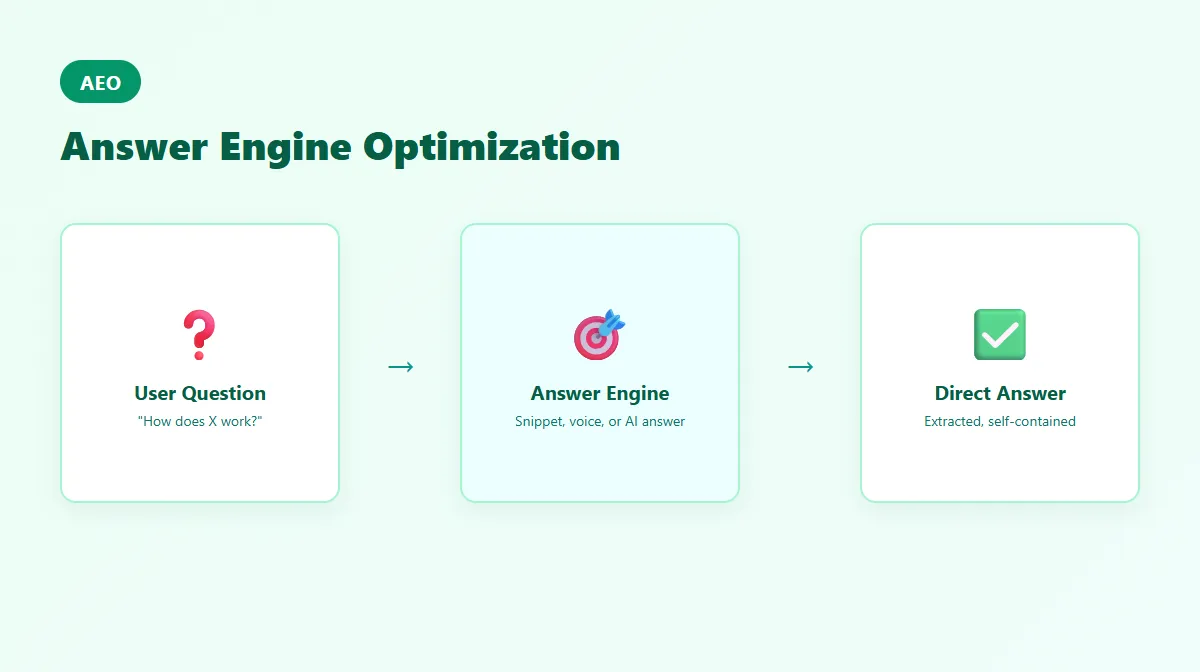
Answer Engine Optimization (AEO) is the practice of structuring content so it can be extracted as a direct, standalone answer — rather than requiring someone to click through to a page and read it in context. It covers a range of "answer" surfaces: featured snippets and "People Also Ask" boxes in traditional search, spoken responses from voice assistants, and answers generated by AI chat and search platforms.
The common thread across all of these is extraction. An answer engine doesn't send a user to your page — it pulls a specific piece of your content out and presents it directly, sometimes with attribution and sometimes without.
What Is Answer Engine Optimization?
AEO is the practice of making a specific fact, definition, or instruction on your page easy for a machine to identify, lift out, and present as a self-contained answer. That means writing in a way that survives being taken out of its original context — a clear claim, a specific number, a complete instruction — rather than a sentence that only makes sense alongside the paragraph before and after it.
AEO predates the current generative-AI moment; it grew out of optimizing for featured snippets and voice search. What's changed is the range of surfaces it now needs to account for, since AI-generated answers work on a similar extract-and-present logic.
How AEO Works
An answer engine — whether it's a featured snippet algorithm, a voice assistant, or an AI chat platform — generally goes through a version of this process:
- Match the question to relevant content. The system identifies pages or passages that appear to answer the specific question asked.
- Evaluate whether the content is extractable. A clearly stated, self-contained answer is easier to lift out cleanly than one buried in a long, hedged paragraph.
- Confirm trust and authority. The system weighs whether the source is reliable enough to present as a confident answer.
- Return the answer, either as text (a snippet, an AI response) or as speech (a voice assistant), sometimes with an attributed source and sometimes without.
The practical implication is that AEO rewards content written the way you'd want a fact to read if it were pulled out of your page and shown on its own.
AEO vs Traditional SEO
Traditional SEO optimizes a full page to rank in a list of results a person scans and clicks through. AEO optimizes a specific passage or fact within that page to be extracted and shown as a direct answer, often with no click involved at all.
The two aren't in conflict — a page still generally needs solid SEO fundamentals (crawlability, topical relevance, credibility) to be considered a candidate source in the first place. AEO is what determines whether a specific piece of that page gets lifted out and used as the answer itself. For the full side-by-side comparison, see AEO vs SEO.
How Answer Engines Select Information
Answer engines differ in mechanics, but a few patterns are consistently observed across surfaces:
- Directness beats build-up. A sentence that states the answer plainly is easier to extract than one that arrives at the point after several sentences of setup.
- Specificity beats generality. A precise number, named source, or exact instruction is more useful to lift out than a vague summary.
- Structure helps extraction. Definitions, numbered steps, and short direct-answer paragraphs are easier for a system to isolate cleanly than dense, unstructured prose.
- Trust still gates selection. Even a perfectly extractable answer from a source the system doesn't consider credible is less likely to be used than a well-sourced one.
Types of Answer Experiences
AEO isn't a single surface — it spans several distinct formats, and each behaves a little differently:
- Featured answers and snippets — a boxed answer shown above traditional search results, typically pulled from a page that already ranks well organically.
- Voice and spoken answers — a single answer read aloud by a voice assistant, with no visual list to scan; there's only one "winner" per query.
- AI-generated answers — a synthesized response from a chat-style AI platform or AI search feature, which may combine information from multiple sources into one answer, sometimes with citations attached.
Optimizing well for one of these doesn't guarantee performance in another — a page that earns a featured snippet isn't automatically favored by a voice assistant or an AI chat platform, since each has its own retrieval and selection logic.
How to Optimize for Answer Engines
- Answer the question directly, early. Put the actual answer in the first sentence of a section, then explain or qualify it afterward.
- Write extractable, self-contained statements. A good test: does the sentence still make sense if it's pulled out and shown with no surrounding context?
- Use question-shaped headings. Headings phrased as real questions ("What is X?", "How do I do Y?") map more directly to how people actually ask answer engines things.
- Structure supporting detail. Numbered steps for processes, tables for comparisons, and short bullet lists for options all make content easier to extract accurately.
- Keep answers current and accurate. An answer engine that returns outdated or incorrect information creates a bad experience for its own users — platforms have an incentive to favor sources that stay accurate over time.
Content Structure for AEO
The clearest AEO-friendly pattern is a short, direct answer followed by supporting depth:
- A concise definition or answer (roughly one to three sentences) that could stand alone.
- Supporting detail immediately after — the "why" or "how," for readers who want more than the direct answer.
- A structured element (list, steps, or table) if the topic involves multiple parts, options, or comparisons.
This pattern serves human readers just as well as it serves extraction — readers who want the quick answer get it immediately, and readers who want depth can keep reading.
FAQs and Direct Answers
Genuine FAQ sections — real questions your audience actually asks, each with a direct, complete answer — are one of the more reliable AEO patterns because they're already structured the way an answer engine consumes content: one question, one self-contained answer. This only works if the questions and answers are accurate and specific; padding a page with generic questions just to add an "FAQ" section doesn't create the same effect.
Structured Data and AEO
Schema markup (FAQPage, HowTo, Article, and similar structured-data types) helps a system understand what a piece of content is and how it's organized. That's a real, documented benefit — but it is not a guarantee of inclusion. No search engine or AI platform has stated that adding schema alone secures a spot in an answer feature. Treat structured data as removing ambiguity about your content's meaning, not as a shortcut around writing genuinely extractable answers.
How to Measure AEO
Measurement quality varies a lot by surface:
- Featured snippets and "People Also Ask" — Google Search Console reports which queries and pages are earning these placements, giving you real, first-party data.
- Voice assistants — there's generally no built-in reporting; testing representative questions yourself is the practical option.
- AI-generated answers — similarly, no standardized public reporting exists across chat-style AI platforms. Most teams track this manually, the same way they'd track GEO performance — see our guide on AI search visibility for what's realistically measurable today.
Common AEO Mistakes
- Writing answers that only make sense in context. If a sentence depends heavily on the paragraph before it, it's hard to extract cleanly.
- Burying the answer. Long introductions before the actual answer reduce the chance of clean extraction.
- Treating schema as a guarantee. Structured data helps comprehension; it doesn't force inclusion.
- Ignoring the underlying SEO foundation. A page still generally needs to be crawlable, relevant, and trusted before it's considered as an answer source at all.
- Assuming one format works everywhere. Snippet-optimized content, voice-optimized content, and AI-answer-optimized content share principles but aren't automatically interchangeable.
Frequently Asked Questions
What does AEO stand for?
AEO stands for Answer Engine Optimization: structuring and formatting content so it can be extracted directly and returned as a standalone answer, rather than requiring a reader to click through and read a full page. It applies to featured snippets, voice assistant responses, and AI-generated answers alike.
Is AEO the same as GEO?
They overlap heavily but aren't identical. AEO is usually framed around being recognized as a fact-level authority that gets extracted into a direct, structured answer — including in non-generative formats like featured snippets. GEO is usually framed around being selected and synthesized by generative AI systems specifically. See our GEO vs AEO comparison for the practical distinction.
Does AEO replace traditional SEO?
No. Answer engines still favor content from sites with established topical authority and technical SEO fundamentals in place. AEO adds a layer of answer-focused structuring on top of that foundation rather than substituting for it.
Does adding schema markup guarantee my content will be used as an answer?
No. Structured data helps a system understand what your content means, but no search engine or AI platform guarantees inclusion in an answer feature just because schema is present. Treat schema as making your content easier to understand and extract correctly, not as a ranking or inclusion guarantee.
What types of answer experiences does AEO cover?
AEO commonly applies to featured snippets and "People Also Ask" boxes in traditional search, voice assistant responses that read out a single answer, and AI-generated answers from chat-style systems and AI search features. Each surface extracts and presents content differently.
How do I know if my content is being used in answer features?
For Google features like featured snippets, Google Search Console shows which queries and pages are earning that placement. For voice assistants and AI chat platforms, there's generally no equivalent built-in reporting, so most teams rely on periodically testing representative questions themselves and recording what comes back.
Try Our Free SEO Tools
Put what you learned into action with our free SEO analysis tools.