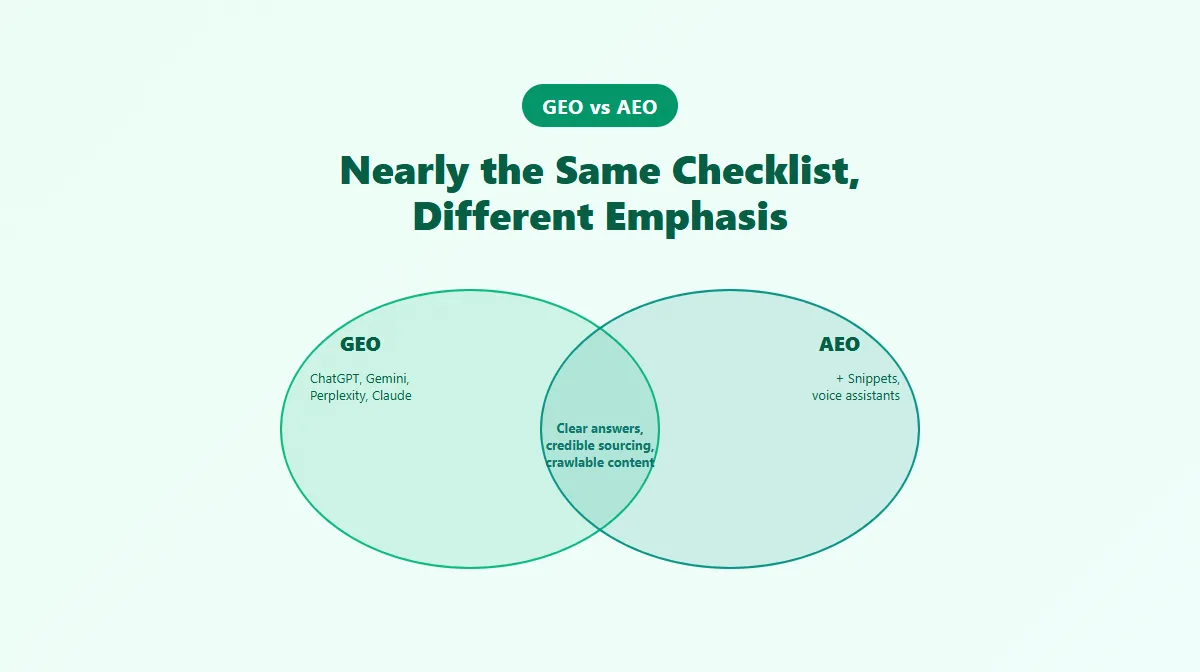
GEO vs AEO: What's the Difference?
GEO (Generative Engine Optimization) and AEO (Answer Engine Optimization) are often used almost interchangeably — and for good reason: the practices that make content perform well under either label are nearly identical. The distinction that does exist is narrow enough that it rarely changes what you'd actually do differently.
The Short Answer
If you're optimizing content to be clear, directly answerable, well-sourced, and structured for extraction, you're doing both GEO and AEO at the same time, regardless of which label you use. The difference is mostly about which surfaces each term tends to emphasize when people use it.
GEO vs AEO: Quick Comparison
| GEO (Generative Engine Optimization) | AEO (Answer Engine Optimization) | |
|---|---|---|
| Typical target platforms | ChatGPT, Google Gemini, Perplexity, Claude | The above, plus featured snippets, "People Also Ask," and voice assistants |
| Origin of the term | Coined alongside the rise of generative AI chat and search | Predates generative AI; grew out of featured-snippet and voice-search optimization |
| Core mechanism | Retrieval-augmented generation — an AI synthesizes an answer from retrieved sources | Extraction — a system lifts a specific, self-contained passage and returns it directly |
| What "success" looks like | Being selected and synthesized into a generated answer, ideally with a citation | Being extracted as the direct answer, in any qualifying format |
| Practical content checklist | Clear answers, topical depth, credible sourcing, crawlability | Nearly identical: clear answers, topical depth, credible sourcing, crawlability |
The last row is the important one: in practice, the same page-level work satisfies both.
Where the Terms Diverge
- GEO is generally used to describe optimizing for generative AI systems specifically — ChatGPT, Google Gemini, Perplexity, Claude — where an AI synthesizes a novel answer from multiple sources. For the full breakdown, see our guide on Generative Engine Optimization.
- AEO is the broader, longer-running term. It predates the current generative-AI period, originating around optimizing for Google's featured snippets and voice assistant answers, and has since expanded to include AI-generated answers as another answer format. See our guide on Answer Engine Optimization for the full scope.
In short: every GEO scenario is also an AEO scenario, but AEO additionally covers older, non-generative answer formats that GEO doesn't typically claim.
Why the Overlap Is So Large
Both disciplines depend on the same underlying mechanics: content has to be crawlable and indexable to be considered at all, retrieval systems favor clear and specific statements over vague ones, and trust/authority signals gate whether a system is willing to use or cite a source. Neither term introduces a fundamentally different technical requirement from the other — they're describing largely the same target from two adjacent angles.
Does It Matter Which Term You Use?
Not much, practically. Some industry commentary treats AEO as the preferred umbrella term specifically because it isn't tied to one generation of AI technology and already covers non-generative answer formats. Others use GEO because it names the generative mechanism directly and maps cleanly to the platforms getting the most attention right now (ChatGPT, Gemini, Perplexity). Either choice is reasonable — what matters is the underlying practice, not the label.
How This Shows Up in Practice
Consider a single well-written page answering "what is a redirect chain." Under a GEO lens, the question is whether ChatGPT or Perplexity might synthesize part of that page's definition into a generated answer, ideally with a citation. Under an AEO lens, the same page might additionally earn a featured snippet in regular Google search, or get read aloud by a voice assistant answering the same question. Nothing about the page changes between the two framings — a clear, self-contained, well-sourced definition near the top of the section serves all of these outcomes simultaneously. The label you use to describe that goal doesn't change the work.
Should You Build Separate Strategies for Each?
No. Building one strategy — clear, direct answers; strong topical authority; credible, checkable sourcing; crawlable, well-structured content — serves both GEO-labeled and AEO-labeled goals at once. Maintaining two separate checklists for the same underlying work adds process overhead without a corresponding practical benefit. If you want the fuller comparison against traditional SEO specifically, see GEO vs SEO or AEO vs SEO — those cover the comparison that actually changes what you'd prioritize.
Frequently Asked Questions
Are GEO and AEO the same thing?
Not exactly, though they overlap heavily and the practical checklist for each is nearly identical. GEO is usually framed around being selected and synthesized by generative AI systems like ChatGPT, Gemini, and Perplexity. AEO is the broader, longer-running term that also covers non-generative answer formats like featured snippets and voice search, and is often framed around structured, fact-level authority.
Which term should I use, GEO or AEO?
It usually doesn't matter much in practice. Some teams and platforms prefer AEO because it predates the current generative-AI wave and covers more answer formats; others prefer GEO because it names the generative-AI mechanism directly. Pick whichever term your audience or industry already uses, and don't expect meaningfully different tactics based on the label alone.
Does optimizing for GEO also help with AEO, or do I need separate work?
In almost all cases, the same work serves both: clear, directly stated answers, strong topical authority, credible sourcing, and crawlable, well-structured content. There's little practical reason to build a separate GEO checklist and a separate AEO checklist for the same page.
What's the one real difference between GEO and AEO worth knowing?
The target surface each term tends to emphasize. GEO discussions center on generative AI chat and search platforms specifically. AEO discussions include those plus non-generative answer formats, like Google's featured snippets and voice assistant responses, that existed before generative AI search became common.
Try Our Free SEO Tools
Put what you learned into action with our free SEO analysis tools.