AEO vs SEO: What's the Difference?
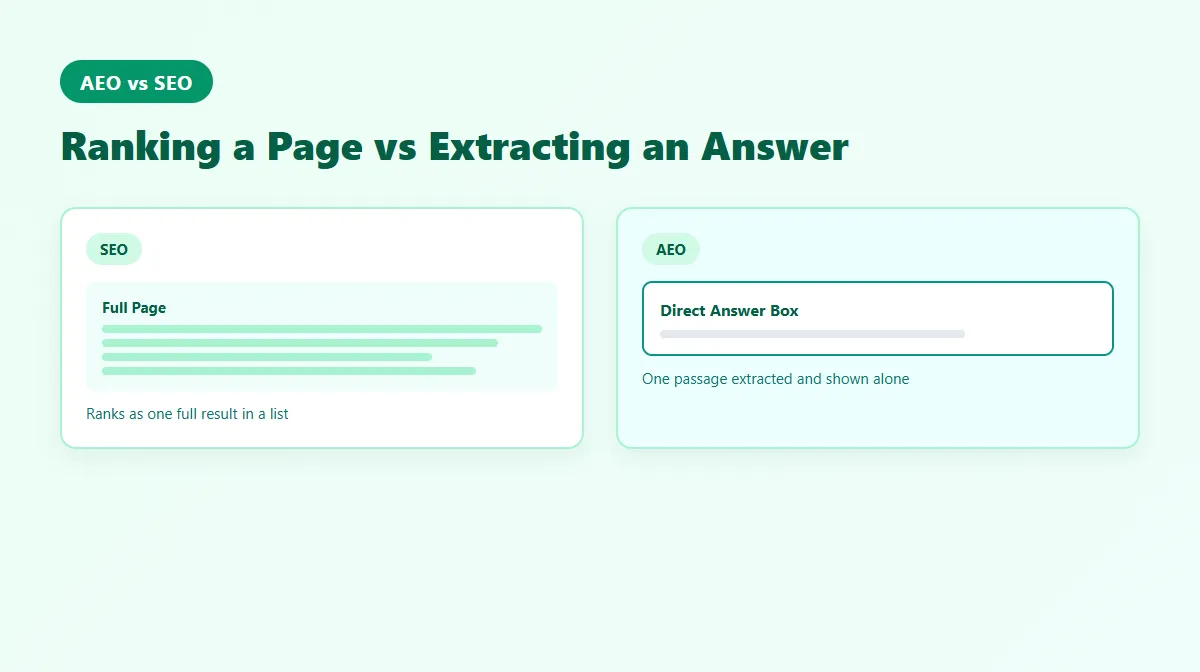
AEO (Answer Engine Optimization) and SEO (Search Engine Optimization) solve related but different problems. SEO gets a page ranked in a list of results. AEO gets a specific answer inside that page extracted and returned directly — as a featured snippet, a voice assistant response, or an AI-generated answer — often without the user ever clicking through.
AEO vs SEO: Quick Answer
AEO and SEO aren't rival strategies. SEO earns visibility in a results list; AEO earns extraction of a specific, self-contained answer from within a page that's often already SEO-relevant. Most pages need both: SEO to be found and trusted, AEO to have its best answer actually pulled out and used.
| SEO | AEO | |
|---|---|---|
| Unit optimized | The full page | A specific, self-contained answer or passage |
| Goal | Rank in a results list | Be extracted as a direct answer |
| Format extracted into | N/A — the result is the link itself | Featured snippet, voice response, or AI-generated answer |
| Requires a click? | Generally, yes | Often no |
| Core content need | Topical relevance, depth, authority | Directness, clarity, self-contained statements |
| Measurement | Search Console, rank trackers | Search Console (for snippets); manual testing for voice/AI answers |
What Is SEO?
SEO is the discipline of optimizing a site so it ranks well for relevant search queries — covering technical health (crawlability, speed, indexability), content relevance and depth, and off-page authority signals like backlinks. Success shows up as ranking position, impressions, and click-through rate.
What Is AEO?
AEO is the discipline of structuring content so a specific fact, definition, or instruction can be lifted out cleanly and presented as a standalone answer. It spans multiple surfaces — Google's featured snippets and "People Also Ask," voice assistant responses, and AI-generated answers from chat platforms. For the full breakdown, see our guide on Answer Engine Optimization.
Key Differences
- What's being optimized: SEO optimizes the whole page's relevance and authority. AEO optimizes a specific passage's extractability.
- The user's next action: SEO assumes a click. AEO frequently ends the interaction with the answer itself — no click required.
- Writing style: SEO content can build context gradually across a page. AEO content needs at least one section that stands completely on its own if pulled out.
- Where it shows up: SEO shows up as a ranked link. AEO shows up as a snippet, a spoken answer, or a synthesized AI response.
Where AEO and SEO Overlap
Both depend on the same underlying requirements: content has to be crawlable and indexable to be considered at all, and it needs enough topical relevance and trustworthiness for a search engine or answer engine to want to use it. In practice, most featured snippets and AI-cited answers come from pages that were already ranking reasonably well organically — extraction tends to happen from sources the system already trusts, not from unranked pages.
Does AEO Replace SEO?
No. A page still needs to be findable and credible through normal search signals before an answer engine is likely to consider a passage from it for extraction. Treat AEO as a refinement applied on top of solid SEO, not a separate strategy that lets you skip SEO fundamentals.
How to Optimize for Both
- Build the page for SEO first: solid topical coverage, clean technical structure, credible sourcing.
- Layer in AEO structure: open key sections with a direct, complete answer before expanding into supporting detail.
- Use question-shaped headings where they match how people actually ask about the topic — this serves both search intent matching (SEO) and extraction matching (AEO).
- Add structured elements (numbered steps, comparison tables, short definitions) for anything that benefits from being lifted out as a unit.
How GEO Fits Into the Picture
GEO (Generative Engine Optimization) is the closely related practice of optimizing specifically for generative AI systems like ChatGPT, Gemini, and Perplexity — a subset of what AEO covers, focused on synthesized answers rather than the full range of answer formats. The practices largely overlap with AEO; see our dedicated guide on Generative Engine Optimization if your priority is AI chat platforms specifically, or GEO vs AEO for how the two labels relate.
Measurement
Measurement quality depends heavily on the surface:
- Featured snippets / "People Also Ask": Google Search Console shows which queries and pages earn these placements — solid, first-party data.
- Voice assistants and AI-generated answers: no equivalent standardized reporting exists across platforms today. Most teams test representative questions manually and record the results, the same approach used for GEO measurement — see AI search visibility for what's realistically measurable, and ProURLMonitor's AI Search Ranking Checker for a structured way to record those manual observations.
Frequently Asked Questions
What is the main difference between AEO and SEO?
SEO optimizes a full page to rank in a list of search results a person scans and clicks through. AEO optimizes a specific, extractable answer within that page to be lifted out and shown directly — in a featured snippet, a voice response, or an AI-generated answer — often without a click at all.
Does AEO replace SEO?
No. Answer engines generally draw from content that already demonstrates topical authority and technical SEO soundness. AEO is a layer of answer-focused structuring on top of that foundation, not a substitute for it.
Can a page rank well in SEO but fail at AEO?
Yes. A page can rank highly in traditional search while still burying its core answer in dense, unstructured prose that's hard to extract cleanly. Ranking well is necessary but not sufficient for being selected as a direct answer.
Do I need separate pages for AEO and SEO?
No, usually the same page can serve both. The adjustment is structural: lead with a direct, extractable answer near the top of a section, then provide the supporting depth that serves both a curious reader and traditional SEO relevance signals.
How does GEO fit into AEO vs SEO?
GEO (Generative Engine Optimization) focuses specifically on being selected and synthesized by generative AI systems like ChatGPT and Gemini. AEO is the broader, longer-running discipline that also includes non-generative answer formats like featured snippets and voice search. The two overlap heavily — see our full guide on Generative Engine Optimization for the GEO side of this.
How do I measure AEO performance versus SEO performance?
For Google-native answer formats like featured snippets, Search Console reports which queries and pages earn that placement. For AI-generated and voice answers, there's no equivalent standardized report — most teams track it manually by testing representative questions and recording what's returned.
Try Our Free SEO Tools
Put what you learned into action with our free SEO analysis tools.