Binary vs Decimal: What's the Difference?
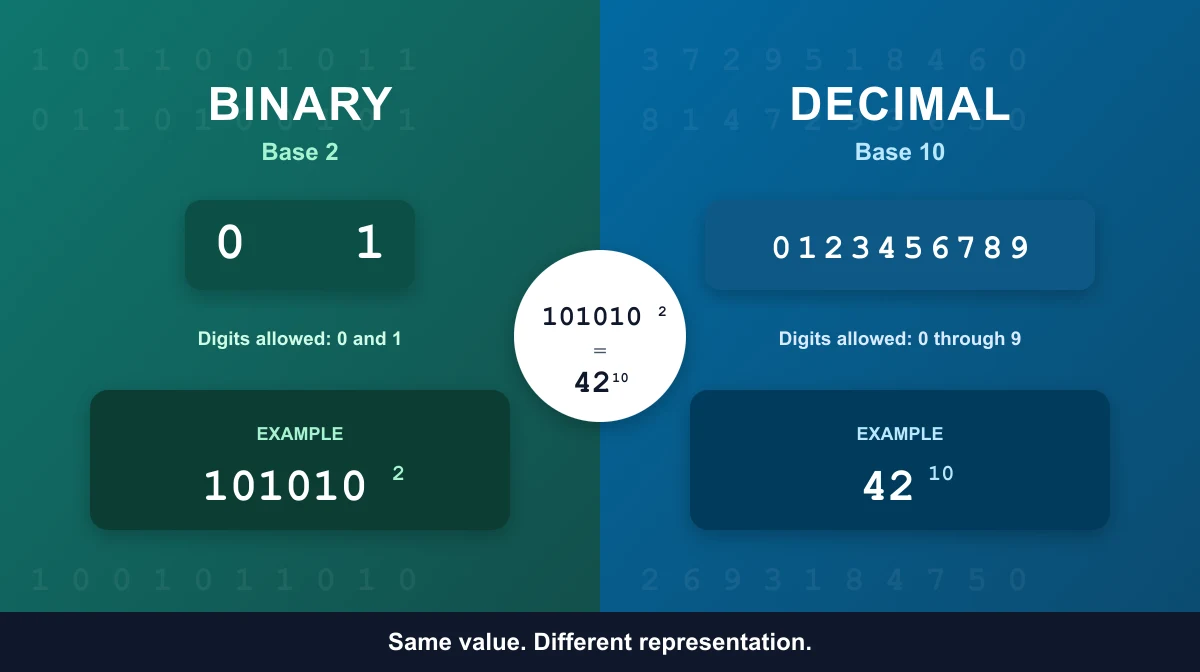
Binary and decimal are both positional number systems used to represent the same quantities — they just do it differently. Decimal is base 10 and uses the digits 0-9. Binary is base 2 and uses only 0 and 1. The number 42 and the number 101010 can represent the exact same quantity; they're just written in two different systems.
The distinction matters because software, hardware, and networking documentation constantly switch between the two. Knowing how each system works — and that they're two representations of the same value, not two different kinds of number — makes it much easier to read binary output, debug bit-level data, and understand why computers are built around binary in the first place.
Binary vs Decimal: Quick Comparison
| Feature | Binary | Decimal |
|---|---|---|
| Base | 2 | 10 |
| Allowed digits | 0, 1 | 0, 1, 2, 3, 4, 5, 6, 7, 8, 9 |
| Place values | Powers of 2 (1, 2, 4, 8, 16…) | Powers of 10 (1, 10, 100, 1000…) |
| Common notation | 101010₂ | 42₁₀ |
| Example (same value) | 101010₂ | 42₁₀ |
| Main use | Digital logic, low-level computing | Everyday counting, measurement, commerce |
| Human readability | Harder to read at a glance | Native to how most people count |
| Computer use | Native to digital hardware | Displayed in interfaces, not used at the circuit level |
| Conversion relationship | Convertible to/from decimal with positional math | Convertible to/from binary with positional math |
What Is the Binary Number System?
Binary is a base-2 number system: every digit (called a bit) is either 0 or 1, and each position represents a power of 2 instead of a power of 10. Counting positions from the right starting at 0, the place values are 1, 2, 4, 8, 16, 32, and so on.
Example: 1011₂
Bit:      1    0    1    1
Position: 2³   2²   2¹   2⁰
Value:    8    4    2    1

(1 × 8) + (0 × 4) + (1 × 2) + (1 × 1) = 11

1011₂ = 11₁₀
That's the full concept — for a deeper walkthrough with more worked examples, see the Binary to Decimal Converter.
What Is the Decimal Number System?
Decimal is the base-10 system almost everyone learns first: ten digits (0-9), with each position representing a power of 10. Counting from the right starting at 0, the place values are 1, 10, 100, 1000, and so on.
Example: 347₁₀
Digit:    3     4    7
Position: 10²   10¹  10⁰
Value:    100   10   1

(3 × 100) + (4 × 10) + (7 × 1) = 347
Decimal is the system used for prices, measurements, ages, and virtually every number a person encounters day to day, which is exactly why it feels effortless compared to reading a long string of 0s and 1s.
What Is the Difference Between Binary and Decimal?
Beyond the base itself, a few practical differences show up whenever the two systems meet:
- Symbols available. Decimal has ten symbols per position; binary has two. That single difference explains almost everything else on this list.
- Place values. Each decimal position is worth 10 times the one before it; each binary position is worth only 2 times the one before it. Binary positions grow much more slowly, so it takes more of them to reach the same value.
- Number length. Because each binary position holds less value, binary numbers need more digits to represent the same quantity as a shorter decimal number.
- Primary usage. Decimal is the human-facing default for counting and measurement. Binary is the native representation inside digital circuits and low-level programming.
- Machine vs. human convention. Decimal was shaped by human counting habits; binary was adopted because it matches how digital hardware distinguishes two electrical states reliably.
None of this makes one system numerically "better" than the other — they describe the same numbers using a different set of rules.
Binary and Decimal Place Values
Both systems work the same way: each position is worth a fixed multiplier of the position to its right. The multiplier is just different.
| Position (right to left) | Decimal value | Binary value |
|---|---|---|
| Position 0 | 10⁰ = 1 | 2⁰ = 1 |
| Position 1 | 10¹ = 10 | 2¹ = 2 |
| Position 2 | 10² = 100 | 2² = 4 |
| Position 3 | 10³ = 1,000 | 2³ = 8 |
Same quantity, two notations:
Binary:  1101₂ = 8 + 4 + 0 + 1 = 13
Decimal: 13₁₀
Both rows describe the value thirteen — the place-value math is identical in structure, just scaled by a different base.
Same Value, Different Representation
This is the point most misconceptions trace back to: binary and decimal numbers aren't different quantities — they're different ways of writing the same quantity.
42₁₀ = 101010₂
Forty-two is forty-two whether it's written with two decimal digits or six binary digits. Nothing about the value changes; only the notation does. Keeping this straight prevents a common trap: assuming that a binary string like 101010 is somehow a different or "more precise" number than 42, when it's just a longer way of writing the same one.
How Do You Convert Binary to Decimal?
Multiply each bit by the power of 2 for its position, then add the results.
Example: 101010₂
1×2⁵ + 0×2⁴ + 1×2³ + 0×2² + 1×2¹ + 0×2⁰
= 32 + 0 + 8 + 0 + 2 + 0
= 42₁₀
That's the entire method. For instant results (plus hex and octal output), use the Binary to Decimal Converter.
How Do You Convert Decimal to Binary?
The standard manual method is repeated division by 2, recording the remainder at each step and reading them back in reverse order.
Example: 42₁₀ → binary
42 ÷ 2 = 21 remainder 0
21 ÷ 2 = 10 remainder 1
10 ÷ 2 =  5 remainder 0
 5 ÷ 2 =  2 remainder 1
 2 ÷ 2 =  1 remainder 0
 1 ÷ 2 =  0 remainder 1

Read bottom to top: 101010
So 42 in decimal becomes 101010 in binary — matching the conversion above in reverse. For quick conversions without doing the division by hand, use the Decimal to Binary Converter, or see how to convert decimal to binary for the full method with more worked examples.
Why Are Binary Numbers Longer Than Decimal Numbers?
Binary has only two symbols per position instead of ten, so each position can carry less information. To represent the same quantity, binary needs more positions.
255₁₀ = 11111111₂
Three decimal digits become eight binary digits for the same value. That's not a sign of inefficiency in how computers store data — bytes, words, and registers are sized around convenient bit counts (like 8, 16, 32, or 64 bits), not around matching decimal's digit count. It's simply a consequence of having fewer symbols available per position.
Why Do People Usually Use Decimal?
Decimal is the number system embedded in everyday human life: prices, measurements, ages, dates, and virtually all arithmetic taught in school use base 10. One long-standing explanation is that humans have ten fingers, which made base 10 a natural counting tool long before formal number systems existed — though this is a widely cited explanation for decimal's origins rather than a settled historical certainty, and other bases (like base 12 and base 60) have also been used by various cultures throughout history.
Whatever its origin, decimal's advantage today is familiarity: it's the system built into how most people already think about quantity, so it stays the default for anything meant to be read by a person.
Why Do Computers Use Binary Instead of Decimal?
Digital hardware is built around circuits that need to reliably tell two states apart — typically a low voltage and a high voltage. Two clearly distinguishable states map naturally onto two digits, 0 and 1. Trying to build reliable circuitry that distinguishes ten separate voltage levels (to represent decimal digits directly) is far less practical and far more error-prone at the physical level.
That's the short version of a much deeper topic in digital logic and computer architecture — the point here is just that binary isn't an arbitrary choice, it matches how the hardware itself works.
Binary vs Decimal in Memory
It's inaccurate to say computers "store everything as decimal" or, just as misleadingly, that they "store decimal numbers as decimal." What digital memory actually stores is bit patterns — sequences of 0s and 1s with no inherent meaning by themselves.
Software decides how to interpret those bit patterns. The same sequence of bits could represent:
- An integer or floating-point number
- A character or string of text
- A CPU instruction
- A pixel's color value
Decimal numbers you see in an app or a spreadsheet are the display of an underlying binary value — the hardware itself is still working with bits; software just formats the result as decimal for people to read.
How Binary and Decimal Relate to Hexadecimal and Octal
Binary, octal, decimal, and hexadecimal are all positional number systems that differ only in base:
- Binary = base 2
- Octal = base 8
- Decimal = base 10
- Hexadecimal = base 16
Octal and hex are popular alternatives to decimal specifically because they convert to and from binary so cleanly: 3 binary bits map exactly to 1 octal digit, and 4 binary bits map exactly to 1 hex digit. Decimal doesn't divide evenly into binary the same way, which is part of why programmers often prefer hex or octal when working directly with binary data.
111₂  = 7₈
1111₂ = F₁₆
For hands-on conversions, see the Binary to Hex Converter and Binary to Octal Converter, or read the full binary vs hexadecimal breakdown of how those two systems relate.
Comparison Examples
| Decimal | Binary |
|---|---|
| 0 | 0 |
| 1 | 1 |
| 2 | 10 |
| 3 | 11 |
| 4 | 100 |
| 5 | 101 |
| 8 | 1000 |
| 10 | 1010 |
| 15 | 1111 |
| 16 | 10000 |
| 42 | 101010 |
| 255 | 11111111 |
Common Binary vs Decimal Misconceptions
"Binary numbers are different quantities from decimal numbers." No — they're different representations of the same quantities. 101010₂ and 42₁₀ describe the identical value.
"1010 always means ten." Only when it's read as binary. As a decimal number, 1010₁₀ means one thousand ten. As a binary number, 1010₂ means ten. The digits alone don't tell you the base.
"Computers display everything in binary." Digital hardware works with encoded bit patterns internally, but interfaces routinely display decimal, hexadecimal, text, and graphics — binary rarely appears in a finished user-facing screen.
"Binary is only used for numbers." Bits can represent any digital data — text, images, audio, instructions — not just numeric values. "Binary" describes the representation, not the type of content.
When Should You Use Binary or Decimal?
Decimal is the right choice for:
- Human-facing measurements and quantities
- Prices and financial figures
- Everyday calculations and general-purpose math
Binary is the right choice for:
- Bit-level programming and debugging
- Digital logic and circuit design
- Bitmasks, flags, and permission bits
- Low-level data formats and computer architecture
In practice, programmers working with binary data often reach for hexadecimal instead of raw binary once numbers get long, since hex is far more compact and still converts cleanly to and from binary.
Binary Arithmetic
Arithmetic — addition, subtraction, multiplication, division — works directly on binary numbers using the same logic as decimal arithmetic, just with carries and borrows happening at powers of 2 instead of powers of 10. See Binary Addition Explained for the addition rules and carrying, Binary Subtraction Explained for the borrowing rules, or use the Binary Calculator for a full walkthrough with worked examples of each operation.
How Are Negative Numbers Represented in Binary?
Writing a minus sign in front of a binary string (like "-101") is a human-readable convention, not how a fixed-width binary integer is actually stored. In practice, computers commonly represent signed integers using two's complement: to get -5 as an 8-bit signed value, take the binary form of 5 (00000101), invert every bit, and add 1, producing 11111011.
The details of encoding and decoding two's complement values are worth a dedicated explanation — see Two's Complement Explained for the full method, or the Two's Complement Calculator for step-by-step conversions.
Frequently Asked Questions
What is the main difference between binary and decimal? Binary is base 2 and uses only the digits 0 and 1, where each position is a power of 2. Decimal is base 10 and uses the digits 0-9, where each position is a power of 10. Both can represent the same quantities — they just use a different base and different digit count to do it.
Why does binary use only 0 and 1? Digital circuits reliably distinguish two states (low and high voltage), which map naturally onto two digits. Distinguishing ten separate voltage levels for decimal digits directly would be far less reliable at the hardware level.
Is binary harder than decimal? The place-value logic is identical in both systems. Binary looks harder mainly because it needs more digits to express the same quantity, not because the underlying math is more complex.
Is 1010 binary equal to 10 decimal? Yes, when 1010 is read as binary: 1010₂ = 10₁₀. Read as a decimal number instead, 1010 means one thousand ten — the base changes the meaning.
Why do computers use binary instead of decimal? Binary matches the two-state logic that digital circuits are built around, making it far more practical to implement reliably than a system with ten distinguishable states per position.
How do you convert binary to decimal? Multiply each bit by the power of 2 for its position and add the results — for example, 101010₂ is 32 + 8 + 2 = 42₁₀. Try it instantly with the Binary to Decimal Converter.
How do you convert decimal to binary? Divide by 2 repeatedly, record each remainder, and read the remainders from bottom to top — for example, 42₁₀ becomes 101010₂. Try it with the Decimal to Binary Converter.
Try Our Free SEO Tools
Put what you learned into action with our free SEO analysis tools.